Cozy Caves and Sleeping Bears: Implementing Hibernation Science Stations in Preschool Classrooms

As winter temperatures drop and seasonal shifts become apparent across various regions, early childhood educators face the annual challenge of translating complex environmental concepts into accessible lessons for young learners. Among the most engaging pedagogical themes for the winter months is animal hibernation—a natural phenomenon that captures the imagination of preschoolers while offering a robust framework for multidisciplinary early education. Recent developments in early childhood curriculum design emphasize interactive science centers that blend biology, mathematics, literacy, and motor skill development, transforming passive learning into active cognitive engagement.
Main Facts of Early Childhood Hibernation Curricula
The implementation of hibernation-themed science stations in preschool classrooms is designed to address multiple developmental domains simultaneously. Rather than isolating science as a standalone subject, modern early childhood frameworks integrate ecological concepts with linguistic, mathematical, and physical milestones.
At its core, a hibernation science station introduces children aged three to five to basic zoological concepts, such as how specific mammals and amphibians adapt to harsh weather conditions and food scarcity by entering a state of regulated torpor. Educators utilize tangible materials—such as cardboard boxes modified to resemble dens, miniature animal figurines, sensory table fillers, and building blocks—to facilitate hands-on exploration.

According to early childhood specialists, these tactile activities serve several foundational purposes:
- Scientific Inquiry: Children explore animal behaviors, seasonal changes, and biological adaptations.
- Language Acquisition: Introduction of specialized vocabulary, including "hibernate," "den," "torpor," and "habitat."
- Mathematical Categorization: Sorting animals by their winter survival strategies (hibernation versus migration or active adaptation).
- Motor Skill Refinement: Gross motor engagement through den construction and fine motor practice via word-tracing and vocabulary cards.
Background Context and Chronological Integration
The integration of seasonal science units into preschool schedules typically follows a structured chronological progression aligned with meteorological winter. Educators generally introduce the concept of hibernation between late November and January, coinciding with observable changes in weather patterns and daylight hours.
Historically, early childhood education relied heavily on two-dimensional learning materials, such as flashcards and coloring sheets, to convey seasonal concepts. However, educational research published over the past decade strongly advocates for constructivist learning environments—classrooms where children construct their own understanding through direct interaction with materials and their environment.
The evolution of the preschool science center reflects this pedagogical shift. By transitioning from teacher-led lectures to student-directed inquiry stations, classrooms now utilize multi-sensory exhibits. The chronological rollout of a hibernation unit typically follows a three-phase timeline:

- Introduction and Observation (Week One): Educators introduce core vocabulary and read literature centered around winter wildlife, utilizing picture books and visual reference posters.
- Interactive Exploration (Week Two): Students engage with structured science stations, matching animal figures to predefined habitats and exploring pre-constructed dens.
- Constructive Application (Weeks Three and Four): Children apply their knowledge by building protective structures using blocks, sensory materials, and recycled items, reinforcing spatial awareness and cooperative play.
Designing the Hibernation Science Station: Materials and Methodology
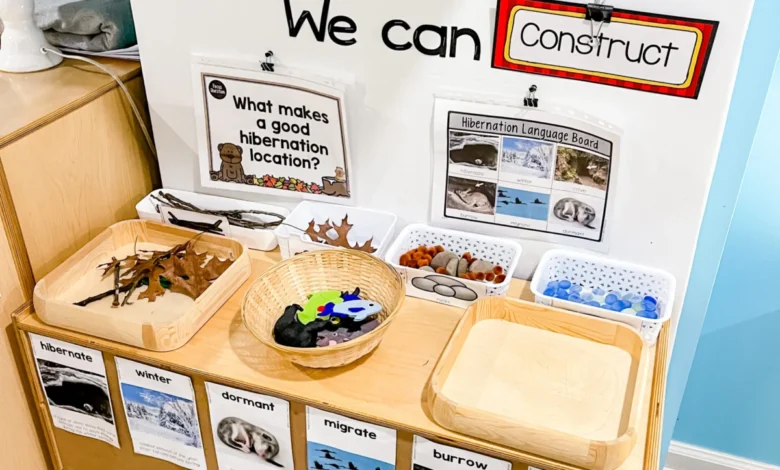
Establishing an effective hibernation learning station does not require expansive floor space or costly equipment. Educational designers recommend utilizing repurposed and everyday classroom items to create immersive, inviting zones. Classrooms typically implement two primary workstation configurations:
Station Configuration A: Guided Matching and Discovery
In this setup, the focus is on comprehension of specific animal habitats. Materials generally include:
- Small cardboard boxes modified with semi-circular cutouts to represent cave entrances.
- Miniature plastic or wooden figurines of animals that hibernate (such as bears, hedgehogs, bats, and frogs).
- Optional non-toxic paint to enhance the visual appeal of the dens.
Students engage by either discovering animals pre-placed inside the appropriate dens or by sorting a mixed collection of figurines and assigning them to their respective winter homes. This activity reinforces observational skills and logical deduction.
Station Configuration B: Architectural Construction
The second configuration shifts from passive matching to active engineering. Students are provided with construction materials—such as wooden blocks, large cardboard boxes, fabric scraps, and sensory table fillers (like artificial leaves, shredded paper, or cotton batting)—and tasked with building secure environments. The objective is to design a structure that protects the hibernating animal from imagined winter elements and predators, thereby fostering spatial reasoning and problem-solving abilities.

Literacy Integration and Text-Rich Environments
The National Association for the Education of Young Children (NAEYC) consistently underscores the importance of a text-rich environment in early childhood settings. During a hibernation science unit, literacy is seamlessly woven into the physical architecture of the classroom.
Educators utilize several strategies to bolster early reading and writing skills within the science station:
- Visual Reference Posters: Displayed at child eye-level near the science area, these charts combine photographic or illustrated examples of hibernating animals with bolded, readable labels. This encourages letter recognition (e.g., associating the letter ‘B’ with ‘Bear’).
- Vocabulary Walls and Tracing Cards: Laminated cards featuring animal names and thematic terms allow children to practice fine motor control by tracing letters with dry-erase markers.
- Thematic Literature: Curated selections of fiction and non-fiction picture books about winter animals are placed directly within the science center, enabling children to cross-reference their hands-on play with informational texts.
Expansion into Other Classroom Centers
A comprehensive pedagogical approach ensures that thematic learning extends beyond the designated science area, permeating every corner of the preschool environment. Experts recommend integrating hibernation concepts into peripheral learning centers:
- Dramatic Play Centers: Transforming the dramatic play area into a "winter forest" allows children to wear bear ears, wrap themselves in blankets simulating dens, and act out the behavioral patterns of winter wildlife, supporting socio-emotional development and imaginative expression.
- Art and Sensory Tables: Utilizing sensory bins filled with dry beans, corn, or shredded paper—representing underground burrows—gives children tactile feedback while hiding small animal counters for excavation exercises.
- Writing and Fine Motor Stations: Providing themed stencils, animal stamps, and journal prompts encourages children to document their discoveries through drawing and early emergent writing.
Broader Impact and Educational Implications
The implementation of targeted science centers focused on natural phenomena like hibernation yields significant long-term implications for early childhood development. By anchoring abstract scientific concepts in tangible, play-based activities, educators lay a cognitive foundation for future scientific inquiry.

Furthermore, data from developmental psychology indicate that early exposure to cross-curricular themes—where science, mathematics, and literacy intersect—enhances cognitive flexibility in young children. As early childhood programs continue to refine their curricula to meet evolving educational standards, low-cost, high-engagement thematic units like hibernation science stations demonstrate that effective learning environments are built not on expensive technology, but on purposeful design, curiosity-driven exploration, and the natural wonder of the world.