Sweet Science: How Educators are Transforming Conversation Hearts into Early Childhood Mathematics Tools

As the middle of February approaches, classrooms across the country invariably find themselves awash in pink, red, and white confections stamped with nostalgic phrases. Among these seasonal staples, Brach’s and other legacy brands of conversation hearts remain a dominant fixture of Valentine’s Day celebrations. However, a growing pedagogical movement among preschool and kindergarten educators is reimagining these sugary tokens not merely as holiday treats, but as sophisticated, hands-on manipulatives for early childhood development. By leveraging the tactile and visual appeal of conversation hearts, teachers are successfully introducing foundational concepts in mathematics, geometry, and fine motor skills to young learners.

The historical trajectory of the conversation heart offers fascinating context to its modern educational utility. Originating in the mid-19th century—when Boston pharmacist Oliver Chase invented a machine that revolutionized lozenge cutting, eventually leading to the creation of NECCO (New England Confectionery Company) wafers—the precursor to the modern sweet evolved to include printed messages in 1866 by Chase’s brother. Over subsequent decades, the manufacturing processes shifted, and the candies took on their iconic pastel hues and distinct chalky textures. When production shifts and corporate acquisitions impacted legacy brands in the late 2010s, educators noted a distinct seasonal disruption, underscoring just how deeply embedded these candies had become in American February classroom traditions. Today, with production stabilized through manufacturers like Brach’s, teachers have formalized these candies into structured, low-prep academic modules that align with early learning standards.
At the core of this educational pivot is the integration of candy heart activities into daily table work. Rather than relying solely on traditional flashcards or digital interfaces, childhood development experts emphasize the necessity of physical manipulatives. According to cognitive development frameworks, children aged three to six learn best through concrete experiences that engage multiple senses. Conversation hearts provide an ideal medium for this developmental stage, offering uniform sizing, distinct color variations, and a manageable weight that encourages fine motor dexterity.

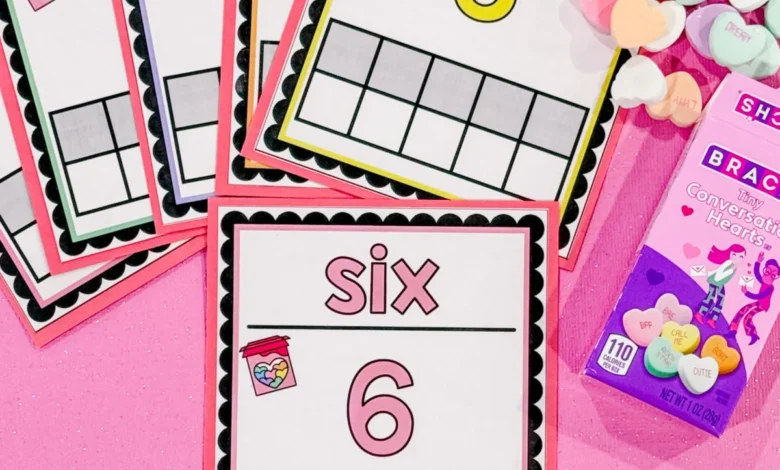
The structured implementation of these activities typically begins with fundamental numeracy. Candy heart counting mats utilize structured visual layouts, such as ten-frames, where students match a printed numeral to a precise quantity of candies. This exercise reinforces one-to-one correspondence—a critical milestone where children learn that each object counted must correspond to one, and only one, number word. Furthermore, because young learners frequently miscount, the tactile nature of sliding and rearranging the physical hearts allows for self-correction. As children adjust their sets and recount, they build autonomous problem-solving capabilities and early mathematical confidence. For advanced kindergarten students, educators frequently expand these counting sessions into introductory subtraction. By instructing children to consume or remove specific quantities from their set, teachers introduce takeaway mathematics in a concrete, highly engaging manner.
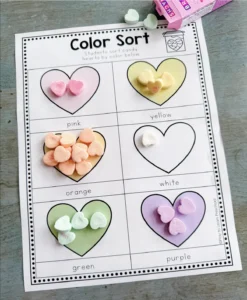
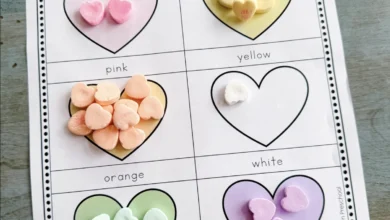
Beyond basic counting, color sorting serves as a vital bridge to data collection and categorization. Standard boxes of conversation hearts feature a diverse palette, typically spanning six distinct colors. Preschoolers are tasked with sorting these candies into corresponding sections of designated color mats. This seemingly simple act of sorting reinforces color recognition and categorical thinking. Once the sorting phase is complete, educators steer the exercise toward analytical discussions, prompting students to evaluate which colors appear with the highest frequency and which are scarcest. This inquiry naturally segues into graphing activities, where students transfer their sorted data onto visual bar or picture graphs. Through graphing mats, children learn to interpret visual data representations, answering comparative questions about quantity that lay the groundwork for elementary statistics.

Pattern recognition represents another crucial domain addressed through these seasonal lessons. Because the candies feature alternating colors and textures, they provide an ideal medium for pattern completion tasks (such as AB or ABB sequences). By identifying the repeating logic of a sequence and placing the correct colored heart in the next slot, students strengthen abstract thinking skills that are essential for future algebraic reasoning.
In addition to arithmetic, educators are utilizing conversation hearts to teach early measurement and geometry. Nonstandard measurement activities involve stacking the candies vertically to determine the height of various printed objects on a worksheet. By aligning the hearts carefully and recording the final tally, students learn the foundational principles of measurement—understanding that an object’s length or height can be quantified by repeating a single unit of measure. Simultaneously, shape-tracing exercises require children to lay the candies continuously along the outlines of basic geometric figures, including circles, squares, triangles, and rectangles. This focused task forces students to slow down, observe spatial boundaries, and acknowledge the distinct properties of shapes, such as the difference between curved edges and sharp corners, thereby reinforcing early geometry standards.

The broader educational implications of incorporating confectionery into curriculum design are viewed favorably by childhood education specialists, provided they are balanced with nutritional awareness and health guidelines. While critics occasionally caution against the use of refined sugars in educational settings, proponents argue that occasional, intentional culinary integration fosters a positive, multisensory relationship with learning. The low cost and high accessibility of these candies also make them an equitable resource for underfunded classrooms, requiring minimal specialized equipment beyond printed mats and standard writing utensils.
Ultimately, the transformation of conversation hearts from simple holiday novelties into rigorous academic tools exemplifies the adaptability of modern early childhood pedagogy. By bridging the gap between play and structured learning, educators continue to demonstrate that foundational math, measurement, and geometry can be taught effectively using everyday objects already present in the cultural mainstream. As long as these pastel tokens line supermarket shelves each February, teachers will undoubtedly find innovative ways to count, sort, and measure their way to academic success.