Transforming Valentine’s Day Candies Into Powerful Early Childhood Educational Tools

The iconic pastel-hued, chalky candy hearts stamped with affectionate shorthand messages have long served as a quintessential symbol of mid-February celebrations. However, early childhood educators and developmental specialists across the nation are increasingly shifting the narrative surrounding these seasonal confections, repurposing them from simple holiday novelties into rigorous, hands-on pedagogical instruments. As preschools and kindergarten classrooms prepare for Valentine’s Day festivities, educational curricula are integrating conversation hearts into structured table tasks designed to foster foundational mathematics, early literacy, and advanced fine motor skills.
This modern shift reflects a broader, research-backed evolution in early childhood education that champions multisensory, play-based learning over traditional rote memorization. By utilizing familiar consumer goods as manipulatives, educators are able to bridge the gap between abstract mathematical concepts and tangible, real-world applications for young learners.
The Pedagogy of Play: Historical Context and Evolution

The integration of edible and household items into classroom instruction is not a novel concept, yet its systematic application during seasonal holidays has undergone significant refinement over the past two decades. Historically, holiday-themed classroom activities centered heavily on arts and crafts, with academic instruction temporarily sidelined in favor of celebratory parties.
However, contemporary educational frameworks, heavily influenced by organizations such as the National Association for the Education of Young Children (NAEYC), emphasize the critical importance of continuous cognitive engagement. Researchers have consistently demonstrated that children aged three to six learn best through active exploration and direct manipulation of physical objects. The incorporation of conversation hearts into structured math and literacy centers represents a direct response to these findings.
By anchoring complex cognitive tasks to a highly recognizable cultural touchstone, educators reduce anxiety associated with early mathematical problem-solving. The bright colors, uniform shapes, and tactile nature of the candies provide an immediate, inviting entry point for students of varying developmental stages, effectively democratizing the learning environment during high-distraction holiday periods.
Core Mathematical Applications: Counting, Sorting, and Graphing

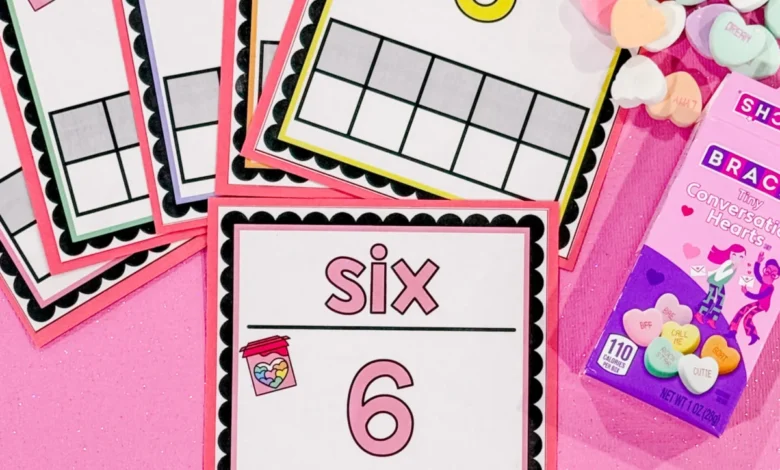
At the center of these seasonal instructional modules are foundational mathematical competencies, specifically designed to meet early learning standards for numbers and operations. Educators employ specialized counting mats featuring ten-frames—a foundational mathematical tool that helps children structure numbers in terms of tens—to cultivate one-to-one correspondence and number recognition.
Students are presented with a numerical target on their mat and are tasked with physically placing the precise quantity of conversation hearts into the designated grid. This physical act of placement and adjustment reinforces the concept of cardinal numbers, teaching children that the final object counted represents the total quantity of the set. Furthermore, educators report that this hands-on approach naturally facilitates self-correction; if a student miscounts, the physical discrepancy within the ten-frame becomes immediately apparent, prompting independent problem-solving.
As students progress in their numerical fluency, instructors introduce early operations. Advanced preschool and kindergarten students routinely engage in basic subtraction exercises by consuming designated quantities of their manipulatives, thereby determining the remainder through direct, multi-sensory observation.
Color theory and data collection are similarly addressed through systematic sorting and graphing exercises. Because a standard box or bag of conversation hearts features a randomized assortment of hues—typically including pink, yellow, green, purple, blue, and white—they provide an organic dataset for young learners.

Students utilize specialized color-sorting mats to categorize their candy collections into distinct sections. Once sorted, classrooms transition into analytical discussions, prompting children to evaluate comparative quantities. Questions such as "Which color appears most frequently?" and "What is the rarest color in your sample?" introduce basic statistical analysis and comparative vocabulary at an age-appropriate level.
Pattern Recognition, Geometry, and Measurement
Beyond basic arithmetic, educators leverage conversation hearts to explore algebraic thinking, spatial reasoning, and non-standard measurement. Patterning is widely recognized by cognitive developmentalists as a crucial precursor to advanced mathematical reasoning, algebraic thinking, and structural understanding.
By utilizing the varied colors of the candies, instructors construct AB, ABB, and ABC patterning sequences on specialized worksheets. Students are challenged to analyze the sequence and logically deduce which color must follow to complete the pattern. This exercise transitions abstract logic into a concrete visual task, allowing children to physically test their hypotheses.

Spatial awareness and early geometry are similarly targeted through shape-tracing activities. Rather than relying solely on writing utensils—which can sometimes frustrate children with developing fine motor control—educators provide outline templates of fundamental geometric figures, including circles, squares, rectangles, and triangles.
Students carefully position the candy hearts along the perimeter of the printed outlines. This deliberate placement forces children to slow down and meticulously observe the structural characteristics of each shape, noting the distinct nature of corners, curves, and linear segments. Concurrently, the pinch-and-place motion required to position the small candies refines the intrinsic hand muscles necessary for future handwriting mastery.
Non-standard measurement rounds out the mathematical curriculum. Rather than introducing formal units such as inches or centimeters immediately, early childhood programs frequently utilize uniform objects to teach the concept of length and height. Students stack conversation hearts vertically alongside printed illustrations of various objects, subsequently counting the total number of candies required to match the height. By recording these numerical totals, children synthesize physical measurement, counting, and fine motor writing skills into a cohesive, interdisciplinary learning experience.
Standardized Educational Resources and Low-Prep Implementation

The growing demand for structured, academically rigorous seasonal programming has led to the proliferation of standardized educational resources designed specifically for early childhood classrooms. Comprehensive curriculum bundles, such as specialized preschool holiday packets, offer educators low-prep, print-and-go materials that align with established state and national early learning guidelines.
Industry analysts note that the market for teacher-created and supplemental educational resources has experienced steady expansion, driven largely by educators seeking high-engagement materials that minimize administrative preparation time. Packets encompassing math, literacy, and fine motor tasks centered around seasonal themes allow teachers to maintain rigorous academic standards during celebratory weeks without overburdening classroom preparation schedules.
According to curriculum developers, the primary objective of these structured packages is to provide equitable access to high-yield manipulatives. While branded conversation hearts—such as those manufactured by industry leaders like NECCO or Brach’s—are traditional, educators frequently adapt these methodologies to utilize alternative counters, ensuring that classrooms with dietary restrictions, allergy concerns, or tight budgets can replicate the exact same cognitive benefits without relying strictly on sugar-based confections.
Broader Implications and Educational Analysis

From a broader pedagogical perspective, the intentional use of holiday-themed confections highlights a profound shift in modern educational philosophy: the dissolution of the artificial barrier between play and formal instruction. Historically, educational paradigms often segregated academic rigor from recreational activities, positing that serious learning required sedentary, lecture-based environments.
Contemporary educational research decisively refutes this dichotomy, demonstrating that sustained attention spans and deep conceptual understanding are maximized when children are emotionally invested and physically active. By transforming a ubiquitous Valentine’s Day candy into a dynamic tool for graphing, patterning, and spatial reasoning, educators validate the child’s natural inclination toward playful exploration.
Furthermore, educational analysts suggest that such activities foster positive emotional associations with mathematics and analytical thinking. For many young learners, mathematics can quickly become a source of anxiety if introduced through rigid, abstract testing methodologies. By grounding early math in a colorful, tactile, and ultimately rewarding experience, educators lay the psychological groundwork for long-term academic resilience and curiosity.
As schools continue to navigate the balance between meeting rigorous developmental standards and maintaining a joyful, engaging classroom environment, the humble conversation heart stands out as a testament to creative pedagogy. Proving that profound lessons in logic, data analysis, and geometry can emerge from the simplest of holiday treats, these educational practices ensure that Valentine’s Day in the modern preschool classroom remains as intellectually stimulating as it is sweet.