February Preschool Activities: Maximizing the Sweet Spot of the School Year Through Routine and Enrichment

As the academic calendar reaches the midpoint of the second semester, early childhood education classrooms enter a uniquely productive phase. By February, young learners have thoroughly acclimated to school daily schedules, classroom spatial arrangements, and behavioral expectations. Educators across the preschool landscape frequently point to this month as a golden opportunity for deep pedagogical engagement, noting that established classroom routines drastically reduce the frequency and friction of transitions throughout the day. With less time spent managing logistics and guiding students from one station to the next, teachers can redirect valuable minutes toward rich conversations, open-ended exploration, and focused skill practice. Rather than constantly introducing novel concepts that require extensive orientation, early childhood professionals increasingly leverage February to revisit familiar activities paired with subtle, seasonal modifications. This pedagogical strategy maintains high levels of student interest and engagement while reinforcing foundational literacy, numeracy, and social-emotional competencies that children have practiced since the autumn term.

The Structural Advantage of the February Classroom Environment
From a developmental standpoint, the predictability inherent in a mid-winter preschool curriculum provides a crucial scaffolding mechanism. Child development specialists and curriculum designers emphasize that repetition is a cornerstone of early childhood cognitive development. When children encounter familiar centers—such as sensory bins, writing tables, and math stations—featuring minor thematic updates like winter motifs or Valentine-inspired color palettes, their cognitive load is significantly reduced. Instead of expending mental energy deciphering how an activity works, young learners immediately access the core objective of the task.

Data compiled by early childhood education networks consistently indicate that classrooms characterized by high predictability and low transition stress yield measurable improvements in cooperative play and sustained attention spans. In February, this translates to longer periods of uninterrupted independent and small-group play. Teachers report that children are more willing to tackle multi-step problems, engage in sustained peer-to-peer dialogues, and explore tactile materials when the parameters of the exercise are already second nature. This structural advantage sets the stage for targeted learning units focusing on literacy, emotional intelligence, and scientific observation.
Redefining Seasonal Themes: Literacy and Communication in Early February

While the cultural calendar highlights Valentine’s Day during the shortest month of the year, progressive preschool programs are increasingly steering away from superficial craft production and commercialized card exchanges. Instead, educators utilize the seasonal shift as a natural springboard for communication, connection, and early literacy development. Language acquisition experts note that preschool-aged children expand their expressive and receptive vocabularies most rapidly when communication serves an authentic communicative purpose rather than a purely rote academic function.
Classrooms across the country are transforming traditional holiday tropes into literacy powerhouses. For instance, writing centers integrated with alphabet-tracing cards, dry-erase markers, and heart-shaped manipulatives encourage fine motor dexterity alongside letter recognition. Furthermore, rhyming puzzles and thematic matching games allow children to deconstruct phonemes—the fundamental building blocks of reading readiness—in a tactile, non-threatening format. Educators observe that when letters are paired with names and shared amongst peers, children begin to grasp the symbolic nature of print with greater clarity and enthusiasm.

Fostering Emotional Intelligence Through Kindness and Friendship Curricula
February is universally recognized in educational circles as National Friendship Month, aligning seamlessly with prevailing winter themes of community and mutual care. Because interpersonal conflicts naturally arise in communal spaces like preschools, February serves as an ideal window to formalize lessons in emotional regulation, empathy, and conflict resolution. Child psychologists emphasize that the ages of three to five represent a critical developmental window for theory of mind—the ability to attribute mental states to oneself and others.

To capitalize on this developmental milestone, educators incorporate structured kindness circles and daily community-building exercises into the morning routine. According to classroom observations gathered by early childhood researchers, deliberate instruction in prosocial behaviors during preschool correlates strongly with positive social integration later in elementary school. Activities designed around sharing, recognizing emotional cues in peers, and cooperative group challenges help children internalize the vocabulary of kindness. When children are given concrete tools to express appreciation or resolve disputes—such as structured apology protocols or collaborative building projects—incidents of aggressive behavior decline, replaced by constructive peer negotiations.
Winter Science and Empirical Observation in the Natural World

Despite the cultural focus on affection and friendship, February remains firmly anchored in the winter season for a vast majority of educational institutions. This temporal intersection of winter weather and seasonal novelty provides a robust context for early scientific inquiry. Rather than reading abstract texts about temperature and states of matter, preschool students engage in direct empirical observation of their immediate environment.
Classrooms frequently deploy winter science stations featuring ice cube exploration, magnifying tools, warm water experiments, and tactile freezing-and-melting containers. These hands-on investigations introduce young learners to the scientific method long before they encounter formal laboratory settings. By observing how ice transforms when exposed to salt, warm water, or ambient room temperatures, children begin to formulate hypotheses, collect qualitative data, and articulate cause-and-effect relationships. Educational analysts note that these concrete scientific experiences foster critical thinking skills, encouraging children to ask probing questions about the physical world and record their observations through drawing and verbal descriptions.

Streamlining Math and Literacy Centers for Maximum Confidence
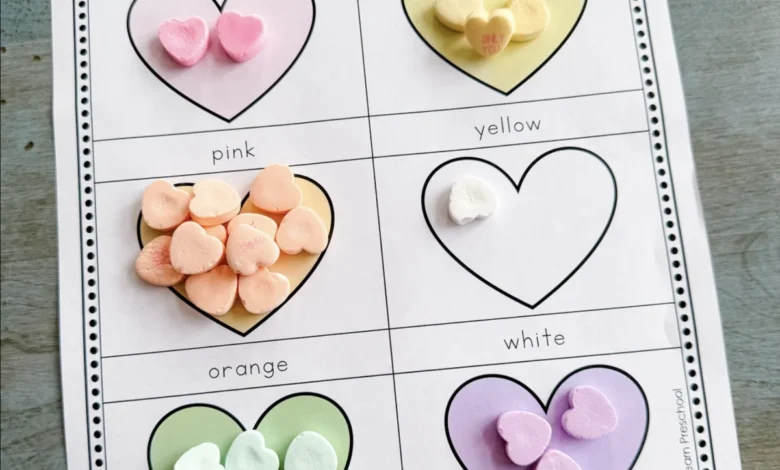
The integration of math and literacy centers during the shortest month of the year relies heavily on the principle of progressive complexity. By February, students have mastered basic sorting, counting to ten, and recognizing foundational shapes. Consequently, educators introduce math and literacy centers that utilize familiar mechanics—such as counting mats, matching games, and rolling dice—infused with subtle seasonal updates, including counting heart manipulatives or sorting pink and red counters.

Data from longitudinal early childhood studies indicate that maintaining consistent center formats while varying the manipulatives reduces anxiety among struggling learners and accelerates mastery for advanced students. When the rules of a math or literacy game are already understood, children can concentrate fully on quantitative reasoning or phonological awareness. Keeping numerical sets small—typically ranging from one to ten—ensures that every child experiences a high rate of success, thereby reinforcing academic self-efficacy and a positive attitude toward mathematics and reading.
Open-Ended Dramatic Play: The Engine of Social and Linguistic Development

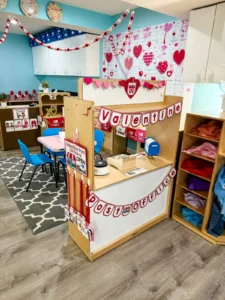
Dramatic play centers represent one of the most vibrant components of the preschool ecosystem, and their efficacy peaks during months like February when children possess high social confidence and established role-playing capabilities. Whether configured as a Valentine-themed post office, a flower shop, or a winter market, open-ended dramatic play spaces provide an unparalleled arena for language practice and social negotiation.
Developmental psychologists emphasize that socio-dramatic play is a primary vehicle through which young children practice self-regulation, perspective-taking, and narrative structure. Within a simulated post office environment, for instance, children naturally assume roles as postal workers, customers, or sorting clerks. This requires them to negotiate rules, share materials, and utilize functional language to achieve shared goals. Because these play spaces are inherently flexible, children of varying developmental abilities can participate at their own comfort level. A child with limited verbal skills might engage primarily through tactile sorting of envelopes, while a more linguistically advanced peer dictates letters, thereby creating an inclusive, differentiated learning ecosystem.

Implications and Future Outlook for Mid-Winter Early Childhood Education
The operational strategies deployed in preschool classrooms throughout February hold broader implications for the trajectory of early childhood education as a whole. Educational policy analysts point to the success of predictable, routine-based mid-year curricula as a model for maximizing instructional time without inducing burnout in young learners. By prioritizing depth of engagement over superficial novelty, educators create a stable foundation that prepares children for the cognitive and social demands of kindergarten and beyond.

As school districts continue to evaluate best practices in early childhood pedagogy, the emphasis on routine, emotional literacy, and hands-on scientific and mathematical exploration in February underscores a vital truth: effective early education does not require constant reinvention. Instead, it thrives in environments where safety, predictability, and purposeful play intersect, allowing every child the time and space to grow, connect, and learn at their own developmental pace.
Related posts: