Early Childhood Educators Introduce Innovative Hibernation Science Stations to Foster Preschool Development and STEM Literacy

As winter temperatures drop and communities transition into the colder months of the year, early childhood educators and preschool administrators are increasingly turning seasonal changes into foundational educational opportunities. Across preschools and pre-K classrooms nationwide, teachers are deploying specialized science and activity stations centered around the biological concept of hibernation. Designed specifically for young learners, these interactive curriculum modules merge natural science with early literacy, mathematics, and motor skill development, offering a comprehensive pedagogical approach to winter science.
The curriculum comes at a critical time in early childhood education, where experts emphasize the importance of experiential, hands-on learning. By exploring how animals adapt to environmental stress, young children gain their first structured exposure to ecology, animal behavior, and seasonal cycles. Educational specialists note that teaching these complex biological adaptations through play helps bridge the gap between abstract scientific concepts and concrete preschool comprehension.
Pedagogical Framework and Multidisciplinary Learning Benefits
The introduction of hibernation-themed learning centers is rooted in a multidisciplinary educational strategy. According to developmental psychologists and early childhood curriculum designers, exploring the ways mammals, reptiles, and amphibians survive harsh winters engages multiple facets of a child’s cognitive and physical growth simultaneously.

From a scientific standpoint, children learn fundamental vocabulary such as “hibernate,” “habitat,” “den,” and “adaptation.” However, the scope of these activity stations extends far beyond basic biology. Early mathematics skills are naturally integrated when students engage in sorting and categorizing exercises—grouping animals by those that sleep through the winter versus those that remain active, or sorting creatures by size and habitat type.
Motor skill development is similarly targeted through tactile engagement. Gross motor skills are refined as children build structural dens and caves using heavy wooden blocks, large cardboard boxes, and sensory table materials like shredded paper, excelsior, or artificial foliage. Meanwhile, fine motor control is enhanced through precision tasks, such as tracing animal names on laminated vocabulary cards, manipulating small plastic figurines, and practicing pincer grasps to arrange props inside miniature dens.
Furthermore, imaginative play remains a cornerstone of these stations. By pretending to be bears, hedgehogs, or squirrels preparing for a long winter sleep, children cultivate empathy, narrative skills, and social-emotional understanding.
Designing the Classroom Space: Core Components and Activity Stations
Implementing a hibernation science center does not require extensive classroom real estate; rather, it relies on the strategic organization of everyday educational supplies. Teachers typically divide the installation into two distinct, interactive activity zones designed to foster both guided and independent learning.

The first zone, focused on examination and matching, utilizes simple recycled materials such as shoeboxes or small delivery cartons. Educators modify these containers by cutting small semi-circular entryways to simulate caves, optionally painting the exteriors to resemble natural rock formations or forest floors. Within this station, students are presented with two distinct methodologies: either discovering pre-hidden plastic animals tucked away within the correct dens, or sorting a randomized collection of fauna and matching each species to its appropriate winter home. This exercise reinforces spatial awareness, problem-solving, and critical thinking.
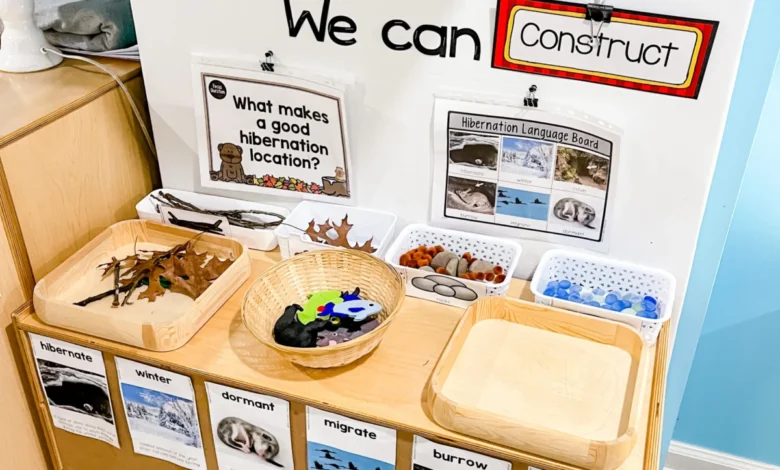
The second zone shifts the focus from passive matching to active construction. In this engineering-focused station, children are challenged to apply their knowledge of animal biology to build secure, weather-resistant shelters. Using interlocking blocks, natural twigs, fabric scraps, and pliable modeling materials, students construct habitats designed to protect vulnerable species from simulated winter storms and potential predators. This constructive play introduces basic engineering principles and encourages iterative design thinking as children test and modify their architectural structures for stability.
Enhancing Literacy Through Text-Rich Environments
In alignment with guidelines established by organizations such as the National Association for the Education of Young Children (NAEYC), modern preschool classrooms increasingly prioritize the creation of text-rich environments. The hibernation curriculum heavily leverages this strategy to accelerate early literacy acquisition during a period of explosive cognitive development.
Classrooms implementing the hibernation stations incorporate visual and linguistic cues directly into the physical space. Large, brightly illustrated reference posters depicting various hibernating mammals are mounted near the science area. These posters serve a dual purpose: they elevate the visual appeal of the classroom decor while functioning as a visual vocabulary bank. Even before children achieve full reading literacy, they begin to make fundamental grapheme-phoneme connections, recognizing, for instance, that the word "bear" begins with the letter "B."

Complementary literacy tools include dedicated vocabulary walls, laminated word-tracing cards, and a curated selection of non-fiction and narrative picture books focusing on winter wildlife. By embedding text directly into the play areas, educators encourage children to reference printed materials autonomously during group collaborations or independent exploration, reinforcing comprehension through repeated exposure.
Expanding Themes Beyond the Science Center
To maximize educational retention and maintain student engagement, curriculum specialists recommend expanding the hibernation theme across various learning centers within the classroom.
In the dramatic play area, children utilize tunnels, blankets, and plush animal toys to enact the complete hibernation cycle, reinforcing sequencing and storytelling skills. The art and writing stations offer opportunities for creative expression, where students utilize stencils, watercolors, and tactile papers to illustrate winter landscapes and subterranean dens. Additionally, sensory tables filled with corn kernels, beans, or faux snow allow children to dig, bury, and unearth toy animals, combining sensory integration with thematic exploration.
Industry Response and Broader Implications
The rollout of structured, thematic science centers has garnered positive reactions from educators and parents alike, who praise the low-barrier, high-impact nature of the materials. Requiring minimal financial investment—often utilizing standard classroom supplies and recyclable goods—these modular kits provide equitable access to quality STEM enrichment across diverse socioeconomic school districts.

As early childhood education continues to pivot toward holistic, inquiry-based learning models, initiatives like the hibernation science stations highlight the enduring value of connecting young learners to the natural world. By grounding complex ecological phenomena in tactile, imaginative play, educators are laying a robust foundation for lifelong scientific curiosity and academic success.
Related posts: