Heart Art on the Light Table Illuminates Early Childhood Classrooms with Hands-On STEAM Learning

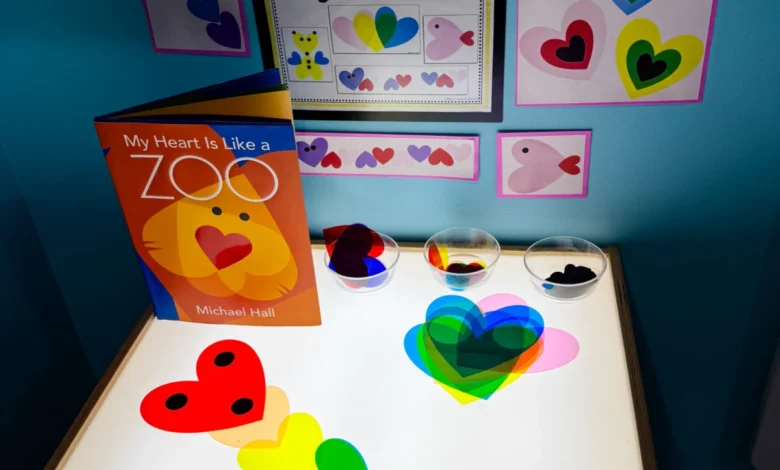
Early childhood education continues to evolve, placing an increased emphasis on sensory-rich environments and experiential learning. Across preschools nationwide, educators are turning away from passive instruction in favor of interactive learning stations that foster creativity, critical thinking, and social development. Among the most popular additions to modern preschool classrooms is the light table—a glowing surface that transforms basic translucent materials into captivating visual puzzles. Recently, educators have introduced a seasonal twist to this sensory staple: heart-shaped art activities tailored for Valentine’s Day and shape-recognition curricula. This low-preparation, high-engagement activity has quickly become a cornerstone for early childhood development, merging aesthetic exploration with fundamental cognitive milestones.

The integration of light tables into early learning environments is rooted in the Reggio Emilia philosophy, which champions the "environment as the third teacher." Developed in Italy following World War II, this pedagogical approach asserts that children learn best through direct physical interaction with their surroundings, utilizing multiple sensory channels. Light tables capitalize on this theory by introducing illumination, a variable that naturally commands human attention and enhances visual acuity. When children manipulate brightly colored, translucent shapes upon an illuminated surface, they are not merely playing; they are actively engaging in the early stages of optics, geometry, and spatial reasoning.
As educational institutions increasingly adopt STEAM (Science, Technology, Engineering, Arts, and Mathematics) frameworks for younger demographics, tools like the light table serve as vital cross-curricular bridges. The heart art activity specifically designed for seasonal themes requires minimal preparation from educators—typically involving just a light table, a selection of translucent colored shapes or transparency sheets, and a touch of imagination. Despite its simplicity, the exercise yields profound educational dividends. According to early childhood development specialists, structured yet open-ended play sessions significantly enhance a child’s ability to maintain focus, process sensory information, and develop fine motor skills.

To understand the growing popularity of light table activities, one must examine the broader historical shift in early childhood pedagogy over the past three decades. During the late 20th century, preschool curricula frequently relied on rigid, worksheet-driven tasks that prioritized rote memorization. However, longitudinal developmental studies published in the early 2000s demonstrated that play-based learning correlates more strongly with long-term academic success, emotional regulation, and social competence. Consequently, school districts and private preschool networks began heavily investing in sensory furniture, including light panels, tactile bins, and light blocks.
The timeline of implementing a light table curriculum typically follows a progressive developmental trajectory throughout the academic year. At the beginning of the fall semester, educators introduce the light table as a free-exploration zone, allowing children to adjust to the sensory properties of glowing surfaces. By winter—often coinciding with seasonal milestones such as Valentine’s Day—teachers introduce more thematic elements, such as geometric shapes, letters, and numbers. This gradual progression ensures that students possess the foundational comfort required to engage in more complex academic tasks, such as color theory experiments and pattern recognition.

From a cognitive standpoint, the heart art light table activity is a masterclass in multidisciplinary learning. When children select different-sized hearts to construct their collages, they are practicing size recognition and proportional reasoning. Simultaneously, the overlapping of translucent colored transparency sheets introduces foundational color theory. For instance, when a child places a translucent yellow heart over a blue heart, the illuminated intersection produces green. This accidental yet captivating discovery prompts young learners to ask scientific questions, formulate hypotheses, and test variables—the very foundation of the scientific method.
Furthermore, the collaborative nature of light table stations fosters critical social-emotional development. Preschool classrooms are vital training grounds for interpersonal communication, empathy, and conflict resolution. Because light tables are typically designed to accommodate multiple children simultaneously, they naturally encourage collaborative play. Students must negotiate design choices, share limited resources, and articulate their creative visions to their peers. Child psychologists note that these low-stakes, peer-to-peer interactions help reduce anxiety, build self-esteem, and cultivate verbal proficiency as children describe their glowing masterpieces to classmates and teachers.

Education experts and preschool administrators have responded overwhelmingly positively to the integration of low-prep, high-impact activities like the light table heart art project. Dr. Elena Vance, a prominent researcher in early childhood curriculum development at the Institute for Child Study, highlights the efficiency and efficacy of such tools. "Modern educators are often overburdened with administrative tasks and lesson-planning fatigue," Dr. Vance observes. "Activities that require minimal preparation yet deliver maximum cognitive engagement are invaluable. They respect the teacher’s time while honoring the child’s innate drive for exploratory play."
Moreover, feedback from classroom teachers underscores the practical benefits of the activity in managing classroom dynamics. The ambient, focused glow of the light table tends to have a calming effect on young children, drawing them into a state of deep concentration. Teachers report that restless students often find a sense of tranquility at the light table center, where the visual feedback of glowing colors provides a soothing sensory output. This self-regulation is particularly beneficial in inclusive classrooms that accommodate children with sensory processing differences or neurodivergent learning profiles.

Looking ahead, the implications of incorporating tactile, illuminated learning stations into early education extend far beyond the preschool classroom. As primary and secondary education systems continue to demand higher levels of visual literacy and creative problem-solving, building these cognitive pathways early is crucial. The ability to analyze spatial relationships, understand color blending, and collaborate effectively in a shared workspace lays a robust groundwork for future achievements in both the arts and the sciences.
Ultimately, the success of the light table heart art activity demonstrates that educational innovation does not always require high-tech solutions or expensive electronic devices. By harnessing the basic elements of light, color, and geometry, educators can create an enchanting environment where play and rigorous learning seamlessly intersect. As preschools continue to refine their approach to early development, glowing stations like the light table will undoubtedly remain an indispensable asset, proving that profound academic journeys often begin with the simplest of tools.