Pedaling for a Cure: Pat McAleer’s Solo 5,000-Mile Cross-Country Bicycle Odyssey Reaches the Midwest in Support of Type 1 Diabetes Research

Type 1 diabetes (T1D) is an autoimmune condition that affects millions of individuals worldwide, requiring a lifetime of vigilant glucose monitoring, insulin administration, and dietary management. Despite decades of medical advancement, a definitive cure remains elusive, leaving advocacy organizations and grassroots fundraisers to continuously push for the research funding necessary to transform treatments. Among the most ambitious individual fundraising efforts of the decade is Ride Pat Ride, a grueling, self-supported 5,000-plus-mile cross-country cycling journey undertaken by Pat McAleer.
Starting his expedition on July 15, McAleer dipped the tires of his bicycle into the saltwater of the Pacific Ocean at La Push, Washington, before steering eastward. His ultimate destination is the Atlantic shoreline at Virginia Beach, Virginia. Three months and more than 1,850 miles into his cross-country trek, McAleer has traversed rugged mountain ranges, expansive plains, and unpredictable weather patterns, all while raising vital financial contributions and awareness for Breakthrough T1D, a leading global organization dedicated to type 1 diabetes research.
From Mountain Peaks to Big Sky Country: A Geographical Evolution
McAleer’s journey began in the towering, forested peaks of the Pacific Northwest and the Northern Rockies. Navigating steep inclines and navigating winding mountain passes presented an immediate test of physical endurance and mental fortitude. In these elevated regions, logistical considerations were heavily dictated by local wildlife. McAleer frequently utilized designated state and national park campgrounds equipped with specialized bear-proof containers and storage poles to secure food and scented items safely away from grizzly and black bears.
As McAleer descended from the mountains into Montana, Wyoming, and North Dakota, the topography shifted dramatically. He entered the vast expanse known colloquially as Big Sky Country, characterized by rolling hills, open prairies, and uninterrupted horizons stretching from edge to edge.
“You go from this forest mountain thing, where you can see a bit into the distance and then you get these big mountaintop views, and then pretty quickly, you’re in the rolling hills and the prairies and plains kind of scenario,” McAleer remarked during a roadside stop at a picnic table in Leonard, North Dakota, roughly three hours outside of Fargo. “They don’t call it ‘big sky country’ for nothing. You can just see from horizon to horizon, and at night, the stars are amazing.”
However, the transition to the plains introduced a formidable new meteorological obstacle: relentless headwinds. While travelers frequently analyze topography when charting a bicycle route, prevailing winds across the central United States can turn seemingly flat terrain into a grueling uphill slog.
“It’s deceiving because in the morning, you look at your route, you look at the topography, and you’re like, ‘Oh, this will be great.’ Not so quick—check the wind!” McAleer noted. “It does feel like you’re climbing one of those mountain passes.”
Navigating Infrastructure: The Reality of Interstate Cycling
Long-distance bicycle touring across the North American continent frequently requires navigating a complex patchwork of federal, state, and local roadways. For much of his itinerary, McAleer has adhered to the Adventure Cycling Association’s renowned Northern Tier Route, a carefully mapped corridor designed to provide cyclists with the safest and most scenic passage across the northern tier of the United States.

Nevertheless, long-distance touring inevitably requires adjustments to changing highway infrastructure. During a segment through North Dakota, McAleer was required to ride a stretch of Interstate 94. While major highways are generally restricted to motorized vehicles, specific rural sections of the interstate system serve as the only viable and safe thoroughfare for cyclists, as parallel local service roads frequently terminate in dead ends.
“It’s the safest way to get from here to there, and there are also no small roads that I could get on,” McAleer explained. “You could go on one of these service roads right next to the interstate, but go down for about 12 miles, it’s going to end in a dead end, and you’ll have to go back.”
McAleer praised the conduct of commercial truck drivers and motorists sharing the highway, noting that semi-truck drivers routinely shifted entirely into the passing lane to afford him a wide safety berth. Outside of this specific interstate transit, his journey has primarily utilized two-lane state highways meandering through rural North Dakota and Minnesota.
The Philosophy of Self-Sufficiency and Gear Management
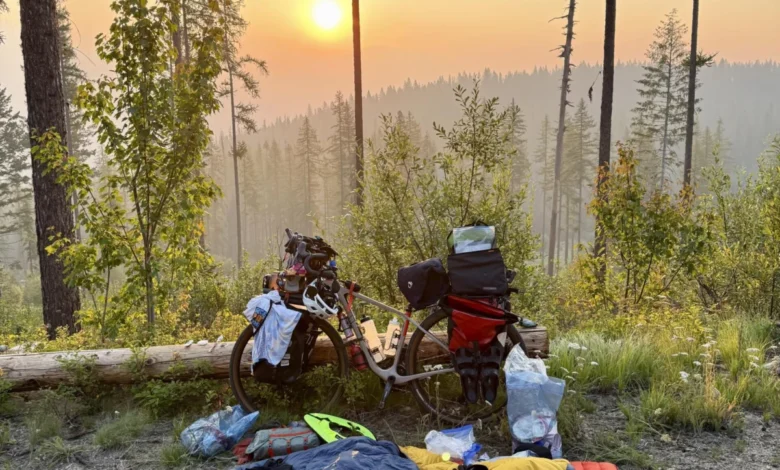
A defining characteristic of McAleer’s expedition is his commitment to absolute self-reliance. When planning the journey, long-distance cyclists generally choose between a light-and-fast approach—depending heavily on motels, restaurants, and external resupply points—or a fully self-supported model that prioritizes total independence. McAleer selected the latter.
His bicycle is outfitted with a comprehensive array of waterproof panniers and saddlebags carrying a tent, sleeping bag, insulated mattress pad, camp pillow, portable cooking stove, provisions, and multiple gallons of water. This heavy configuration is supplemented by essential personal items, communication devices, and clothing.
“It adds some weight, which is a little more work, but it gives me an incredible amount of flexibility,” McAleer stated. “You’re able to just say, ‘Well, I’m tired and then this is as far as I’m going.’”
True to the experience of many first-time transcontinental cyclists, McAleer quickly realized he had initially packed excess items. A few days into the expedition, he mailed a box of redundant gear back to his starting point, discarded an uncomfortable hydration backpack in favor of a simpler water jug, and streamlined his equipment list. Along the way, he has adapted to environmental hurdles by purchasing specialized gear at local hardware and big-box stores, including a wide-brimmed sun hat modified to fit beneath his bicycle helmet and a respiratory mask to safely navigate dense wildfire smoke lingering in the atmosphere.
Grassroots Hospitality and Community Encounters
The human element of cross-country touring has provided some of the most memorable moments of the expedition. Free from rigid hotel reservations, McAleer often improvises overnight lodging in small, rural communities. A quintessential example occurred in Moffitt, North Dakota, a municipality consisting of a few residential streets, a post office, and a local tavern.
Arriving late on a Sunday evening, McAleer approached the local bartender to inquire about pitching his tent discreetly behind the adjacent post office. The bartender offered immediate reassurance, telling him that no local residents would object and jokingly instructing him to invoke the name of a local resident named Darnell if questioned. The following morning, true to the small-town spirit of the region, a local resident walked up to his campsite bearing two hot cups of coffee after noticing the lone traveler packing up his tent.

Another striking encounter took place at a rural convenience store in the Upper Midwest. Seeking refuge from the physical exhaustion of the afternoon, McAleer stopped for a large lunch. Store operators in the region routinely offer complimentary refreshments to cross-country cyclists, and upon recognizing the purpose of his athletic jersey, staff welcomed him warmly. Overwhelmed by fatigue, McAleer inadvertently fell asleep at his table, resting his head directly on top of his navigational map.
Rather than disturbing him, the employees permitted him to rest. Upon waking, McAleer jokingly asked how long he had slept, prompting the staff to reveal that they had spent his rest period researching his athletic campaign online. Touched by his dedication to T1D research, the two workers made a combined $140 financial contribution to Ride Pat Ride.
“This guy working this counter, and this other lady working on the other side of the counter making lunches and stuff, together, they kick in 140 bucks because I was taking a nap and they get curious about why this guy’s sleeping in a convenience store,” McAleer reflected. “They were hosting me in their store by, you know, just taking care of me. It just brought out the goodness of people and let me, once again, be reminded of that.”
Broader Impact, Fundraising Mechanics, and Future Outlook
McAleer’s transcontinental journey is officially registered through Breakthrough T1D Your Way, a DIY fundraising platform that empowers individuals to design customized community campaigns while providing organizational infrastructure, secure donation processing, and logistical backing.
For individuals inspired by McAleer’s feat but unable to commit to a three-month transcontinental cycling tour, Breakthrough T1D offers structured alternatives, including organized destination rides held across multiple national locations annually, as well as virtual participation options through the My Ride program.
As McAleer progresses past Wisconsin and moves steadily toward the East Coast, health advocates and T1D researchers continue to monitor his campaign. Grassroots initiatives of this scale serve a dual purpose: they generate direct financial resources to accelerate laboratory innovations toward clinical trials, and they elevate public consciousness regarding the daily realities faced by individuals managing type 1 diabetes.
Supporters and followers can track McAleer’s remaining miles via his dedicated social media channels on Instagram and Facebook, where he posts regular dispatch updates from the road as he pedals closer to the Atlantic Ocean in Virginia Beach.
Related posts: