Heart Art on the Light Table Illuminates Early Childhood Classrooms with Hands-On STEAM Learning

Early childhood education continues to evolve, with educators increasingly moving away from rote memorization toward experiential, sensory-driven learning models. Across preschools nationwide, light tables have emerged as cornerstone learning centers, prized for their ability to captivate young learners through luminescence and visual inquiry. A prominent example of this pedagogical shift is the implementation of heart-themed light table art activities, widely adopted for seasonal celebrations like Valentine’s Day and broader shape-recognition curricula. By combining simple translucent materials with ambient illumination, educators are turning routine classroom stations into dynamic environments that foster foundational cognitive, physical, and social development.
Background and Context of Light Table Pedagogy
The integration of light tables into early childhood classrooms traces its roots to the Reggio Emilia approach, an educational philosophy focused on self-guided, experiential learning in a relationship-driven environment. Light tables utilize transparency, contrast, and color to draw children into exploratory play, transforming abstract concepts into tangible experiences.
Historically, light boxes were used primarily in clinical settings or specialized therapeutic environments to assist children with visual impairments. Over the past three decades, however, early childhood developmental specialists have championed their broader implementation. Research in cognitive development indicates that children aged three to five absorb complex mathematical and scientific principles more effectively when engaged in multisensory manipulation. The light table provides a high-contrast canvas that isolates visual stimuli, helping to extend attention spans and deepen focus.

Structuring the Activity: Implementation and Preparation
Classroom integration of light-based art activities requires minimal preparation, a significant benefit for educators managing fast-paced daily schedules. According to early childhood curriculum guidelines, successful learning centers must balance low setup overhead with high engagement potential.
The preparation process is typically streamlined into a three-step protocol designed to maximize instructional time:
- Material Gathering: Educators procure a selection of translucent colored items, predominantly geometric shapes such as hearts of varying dimensions, cut from specialized plastic transparency sheets or acrylic manipulatives.
- Surface Sanitization and Setup: The light table surface is cleaned to ensure optimal light diffusion, and the materials are arranged in accessible sorting trays to encourage independent student selection.
- Illumination and Introduction: The table is powered on, casting an even, soft glow across the workspace, signaling to students that the center is open for exploration.
This low-friction setup allows teachers to transition quickly between thematic units, adapting the light table for geometric shape reviews, color theory lessons, or seasonal events without extensive logistical strain.
Cognitive and Developmental Implications

While children perceive the light table primarily as a creative outlet, developmental psychologists and educators view it as a sophisticated instrument for early childhood skill acquisition. The heart art activity specifically targets several key developmental domains outlined by early learning standards.
Size and Spatial Recognition
When children select and arrange hearts of differing scales, they actively engage in comparative measurement. Sorting items by dimension—small, medium, and large—builds foundational mathematical frameworks. Children learn to recognize spatial relationships, symmetry, and geometric proportions as they position the pieces to form larger collages or patterns.
Color Theory and Optical Science
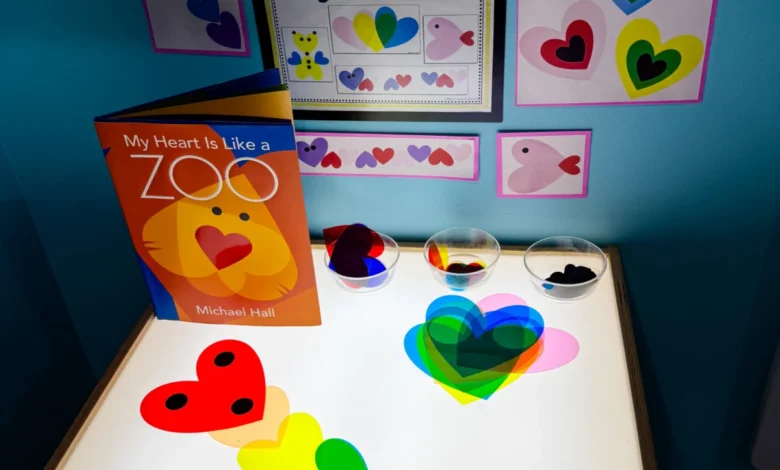
Translucent materials introduce young learners to the basics of optical physics and color blending. When a child places a yellow translucent heart over a blue one, the overlapping transparency generates a distinct green hue. This hands-on experimentation transforms abstract concepts of primary and secondary colors into observable phenomena, encouraging scientific inquiry and hypothesis testing at a preschool level.
Fine Motor Precision
Manipulating small transparency sheets requires refined hand-eye coordination and pincer grasp control. The delicate placement, layering, and adjustment of the pieces strengthen intrinsic hand muscles, preparing children for subsequent milestones such as handwriting and tool usage.
Social Dynamics and Collaborative Learning

Beyond individual cognitive gains, light table activities serve as incubators for social-emotional development. Preschool classrooms are critical environments for teaching cooperative behavior, conflict resolution, and verbal communication.
Because light tables typically accommodate two to four children simultaneously, they naturally encourage peer interaction. Observational studies in early childhood settings indicate that the calming ambient light of the table tends to lower noise levels and moderate behavioral outbursts compared to high-activity centers like block areas or dramatic play zones.
Working side-by-side, children must negotiate design choices, share limited color resources, and articulate their creative visions. Phrases such as "Can I use the red heart next?" or "Look how the purple is made when these two cross over" highlight the spontaneous language acquisition that occurs in these spaces. Educators note that these collaborative exchanges build foundational empathy, active listening skills, and peer bonding that extend beyond the classroom boundary.
Industry Response and Professional Perspectives
Early childhood educators and curriculum developers have widely endorsed the integration of thematic, low-prep light table modules. Proponents argue that such activities bridge the gap between structured academic instruction and child-led play, aligning with modern developmental psychology standards.

"The beauty of light table activities lies in their open-ended nature," notes Dr. Elena Vance, an early childhood curriculum consultant based in Chicago. "Children are not handed a worksheet with a predetermined outcome. Instead, they are given tools to investigate light, color, and geometry on their own terms. When you introduce a theme like shape-based art, you capture their immediate interest while preserving the integrity of self-directed discovery."
Administrators also value the cost-effectiveness and adaptability of transparency-based centers. Because the primary materials—transparency sheets, lightweight plastics, and basic cutouts—can be sanitized and reused indefinitely, schools maximize their instructional budgets while minimizing material waste.
Broader Impact on Early Childhood Education
The enduring popularity of light table art points toward a broader trend in early childhood education: the prioritization of environments that stimulate curiosity and critical thinking from the earliest ages. As schools face mounting pressure to demonstrate early academic readiness, educators are increasingly rejecting rigid, desk-bound instruction in favor of environments that stimulate multiple senses simultaneously.
By transforming a simple geometric shape like a heart into an interactive lesson in physics, mathematics, and social collaboration, teachers demonstrate that high-impact learning does not require complex technology or expensive equipment. Instead, meaningful educational outcomes continue to stem from the intersection of thoughtful design, basic materials, and a glowing space to create.
Related posts: