Bringing the Wild Indoors: How Educators Are Transforming Preschool Science Centers with Hibernation Stations

As winter weather settles in across various regions, early childhood educators are increasingly turning seasonal changes into dynamic learning opportunities. Among the most popular and pedagogically effective themes for early education classrooms during the colder months is the study of animal hibernation. Far beyond a simple seasonal craft, structured hibernation-themed science centers are becoming a staple in preschool and pre-kindergarten curricula, offering a multifaceted approach to early childhood development that blends natural science, vocabulary acquisition, and motor skill enhancement.
The Educational Value of Hibernation Stations
Integrating hibernation concepts into early learning environments addresses several core developmental domains simultaneously. According to early childhood education specialists, teaching children how various species adapt to dropping temperatures provides a foundational introduction to biological sciences, ecology, and seasonal cycles. However, the academic implications extend well beyond basic zoology.

When children encounter terms such as “hibernate,” “habitat,” and “den,” their linguistic capacity expands rapidly. Early math skills are naturally incorporated as students sort, classify, and categorize different animals based on their winter survival strategies. Furthermore, tactile activities—such as constructing dens using wooden blocks, cardboard boxes, and sensory table materials—strengthen gross and fine motor skills. Laminated word-tracing cards help refine pencil grip and letter recognition, while imaginative play allows children to physically and emotionally connect with the subject matter by role-playing as forest animals preparing for the long winter sleep.
Designing the Classroom Science Center
Educational experts emphasize that setting up an effective hibernation science station does not require expansive floor space or expensive equipment. Most necessary supplies consist of everyday classroom items, recycled boxes, and standard manipulative toys.
Classrooms typically divide these hands-on exploration areas into distinct focal points. One common setup focuses on animal habitats and cave structures. Educators often take a simple cardboard box, cut a small semi-circle to mimic a cave entrance, and optionally paint the exterior to resemble a snowy hill or rocky outcrop. Toy animals can then be hidden inside the structure for students to discover, or laid out on a table alongside various dens for a matching exercise.

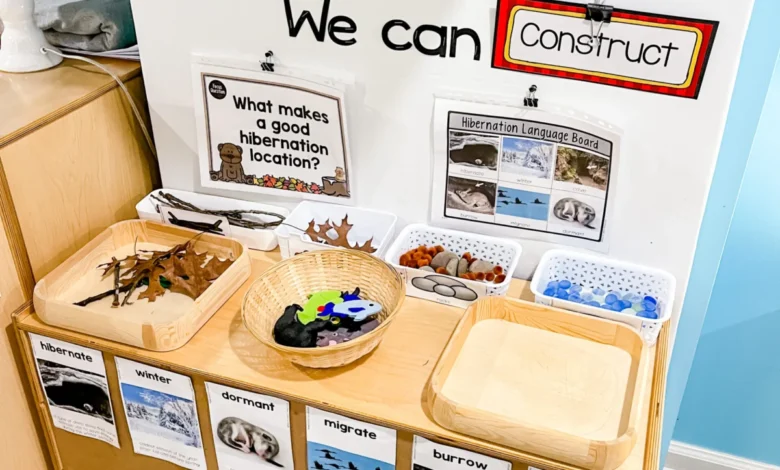
A secondary configuration shifts the focus from passive discovery to active construction. In this setup, students are provided with building blocks, natural elements like twigs and leaves, and fabric scraps. Instead of merely locating pre-hidden creatures, children use their newly acquired knowledge to engineer secure, protective shelters designed to keep specific animals safe from harsh weather and hypothetical predators.
Cultivating a Text-Rich Environment
Modern pedagogical research consistently underscores the importance of a text-rich environment in early childhood settings. Early literacy initiatives encourage educators to leverage the physical classroom space to reinforce reading and writing skills.
To achieve this, teachers often position reference posters detailing various hibernating species directly adjacent to the science center. While preschool students may not yet possess full reading fluency, visual aids paired with labels allow them to make critical cognitive leaps—such as recognizing that the word “bear” begins with the letter “B.” Supplementary resources, including dedicated vocabulary walls, word-tracing stations, and narrative picture books focusing on winter wildlife, provide continuous literacy reinforcement during both structured group lessons and independent exploration time.

Expanding the Theme Across the Curriculum
While science centers serve as the primary hub for hibernation units, educational best practices encourage cross-curricular integration. Progressive preschool programs are increasingly embedding the hibernation theme into various learning zones throughout the classroom.
In art and writing stations, children are encouraged to sketch their own imagined winter dens or dictate stories about what it feels like to sleep through the winter months. Sensory tables filled with faux snow, cotton batting, or shredded brown paper provide tactile feedback that mirrors the bedding materials used by animals in the wild. Dramatic play areas are frequently transformed into cozy caves, complete with plush animal costumes and sleeping bags, allowing children to physically enact the physiological slowdown associated with torpor and hibernation.
Broader Implications for Early Childhood Education
The growing emphasis on thematic, hands-on science stations reflects a broader shift in early childhood pedagogy. Rather than relying solely on rote memorization or abstract lectures, contemporary early education prioritizes experiential learning that mirrors real-world phenomena.

By grounding scientific concepts in tangible, imaginative play, educators lay a robust foundation for future academic engagement. Programs that successfully integrate science, literacy, and motor development through unified themes like hibernation report higher levels of student engagement and improved retention of complex vocabulary. As schools continue to seek innovative ways to meet diverse developmental benchmarks, structured nature-based learning centers remain a vital and enduring component of modern early childhood education.
Related posts: