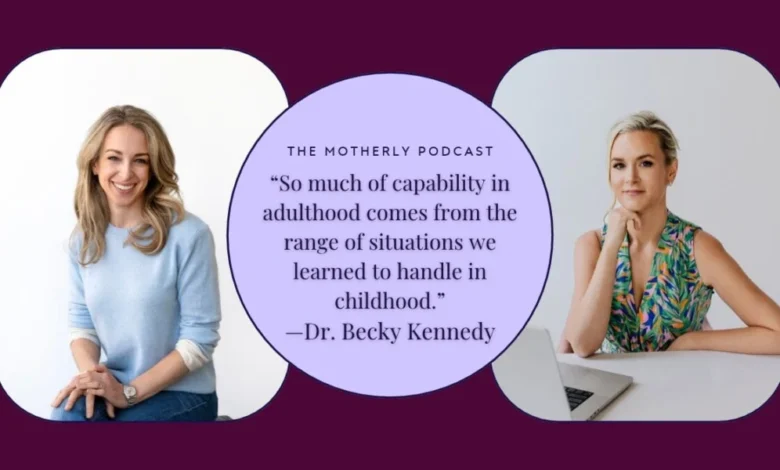
In an era where digital connectivity and instant gratification have fundamentally altered the landscape of modern child-rearing, clinical psychologist Dr. Becky Kennedy is advocating for a profound shift in how parents approach the development of resilience. As the founder and CEO of Good Inside, Dr. Kennedy has become a leading voice in the parenting sphere, offering a framework that prioritizes long-term psychological capability over immediate comfort. Her recent appearance on The Motherly Podcast highlights a growing movement among experts to move away from "happiness-focused" parenting—which some researchers argue fosters anxiety—toward a model centered on building self-trust and emotional regulation.

The core of Dr. Kennedy’s philosophy is built upon two pillars: the consistent application of boundaries and the validation of feelings. According to her, these are not merely suggestions for better behavior but essential components for a child’s development of a secure sense of self. By navigating challenging situations with support rather than immediate interference, children learn to tolerate discomfort, a trait she identifies as a precursor to true confidence.

The Psychology of Modern Parenting Challenges
The current generation of parents faces a unique set of pressures, often described by sociologists as "intensive parenting." Data from the Pew Research Center suggests that modern parents are more involved in their children’s lives than any previous generation, spending significantly more time on direct engagement and supervision. While intended to improve outcomes, this high level of involvement has created a phenomenon where parents feel compelled to remove every obstacle from their child’s path.

Dr. Kennedy characterizes this as a "dis-service" to the child’s capacity for resilience. She illustrates this with a personal anecdote regarding her daughter, who, while away at summer camp, requested expensive, branded apparel to fit in with peers. Upon speaking to her daughter days later, the immediate sense of urgency had vanished. This example serves as a clinical metaphor for the broader issue of "urge management." When parents act as a buffer against all perceived distress, children lose the opportunity to realize that their intense, temporary emotional states—panic, jealousy, or social discomfort—are survivable.

Redefining the Two Primary Roles of a Parent
During her conversation with Liz Tenety, Dr. Kennedy outlined a functional, simplified job description for parents, intended to reduce the "parenting overwhelm" that often leads to burnout. She argues that parents should focus on:

- Setting Boundaries: Contrary to common belief, boundaries are not requests. They are authoritative decisions made by the parent that provide structure. A request—such as "Please stop jumping on the couch"—often invites negotiation. A boundary, however, is an assertion of safety and expectation. It requires nothing from the child, but rather dictates the parent’s own actions and limits.
- Validating Feelings: This does not equate to agreement. Validation is the act of recognizing a child’s emotional reality without allowing that emotion to dictate the household’s rules. This separation of "feeling" and "behavior" is vital for emotional intelligence.
By fulfilling these two roles, parents answer the fundamental, unconscious questions children ask: "Am I safe?" and "Am I real?" When a parent holds a boundary while simultaneously acknowledging the child’s frustration, they create an environment where the child feels both contained and understood.

The Problem with the "I Just Want My Kid to be Happy" Paradigm
For decades, the standard aspiration for parents has been to ensure their child’s happiness. Dr. Kennedy challenges this, suggesting that prioritizing happiness above all else is a recipe for fragility. This perspective is supported by various studies in developmental psychology, which suggest that a child who is shielded from sadness or frustration never develops the "muscle" required to handle life’s inevitable setbacks in adulthood.

If a parent’s goal is to remove all unhappiness, the child is never given the chance to experience, process, and recover from failure. This lack of experience creates a "shrinking life," where the individual avoids any situation where they might not be the best or might encounter difficulty. True confidence, according to Dr. Kennedy, is not the feeling of being the best; it is the self-trust that one can navigate a situation even when it is difficult or when one is not succeeding.

Practical Implementation: The "One Foot In, One Foot Out" Method
Addressing the anxiety parents feel when their children struggle—such as receiving a poor grade or being left out of a social group—Dr. Kennedy proposes the "one foot in, one foot out" approach. This method allows parents to remain present and supportive without taking over the child’s problem-solving process.

- One Foot In: This involves verbalizing empathy. For instance, acknowledging that a zero on an assignment is indeed a "bummer" and that the child’s feelings of frustration are valid. This keeps the parent connected to the child’s experience.
- One Foot Out: This involves maintaining perspective. After acknowledging the emotion, the parent helps the child view the event as a discrete incident rather than a defining characteristic of their entire identity. It is the reminder that they are the same capable individual before and after the failure.
This balance prevents the parent from being perceived as a dismissive observer while avoiding the "helicopter" impulse to fix the problem on the child’s behalf.

The Role of Technology and the "Urge"
The digital age has exacerbated the issue of patience. With the rise of e-commerce, instant messaging, and social media, the delay between "urge" and "satisfaction" has nearly vanished. Dr. Kennedy notes that when a child has an urge—whether it is for a new item or a quick fix to a social conflict—the ability to satisfy that urge immediately is detrimental. The waiting period is where resilience is built. By slowing down the process of response, parents provide the space necessary for the initial, heightened emotional reaction to subside.

Industry Impact and Future Initiatives
Dr. Kennedy’s influence extends beyond her books and podcast appearances. Her platform, Good Inside, has become a hub for evidence-based parenting strategies, and her recent collaboration with Carter’s to launch the "Childhood Confidence Project" reflects a broader corporate and societal recognition of the need for these resources. This free program aims to provide parents with the tools to foster capability in children, indicating that the shift in parenting philosophy is reaching mainstream audiences.

The broader implications for society are significant. As mental health professionals report record levels of anxiety and depression among youth, the move toward building resilience at home is seen by many as a vital public health intervention. If children can be taught that discomfort is a manageable part of life rather than a state to be avoided, the long-term mental health outcomes for the next generation could improve substantially.

Conclusion: The Confidence to Think Through Problems
Perhaps the most reassuring takeaway from Dr. Kennedy’s message is the permission it grants parents to be imperfect. She acknowledges that even she does not "nail" her own scripts. The goal is not to perform a perfect parenting routine, but to possess a repeatable way of thinking through problems.

When parents move away from asking, "What should I do?" and start asking, "What is really going on here?" they regain their own confidence. This shift allows parents to move from a state of reactive stress to one of thoughtful, authoritative guidance. Ultimately, the confidence parents seek to build in their children begins with the confidence they build in themselves—the trust that they can think through any hard moment, not by having all the answers, but by having the tools to navigate the unknown with their children.