Heart Art on the Light Table Illuminates Early Childhood Classrooms with Sensory-Rich STEM Learning

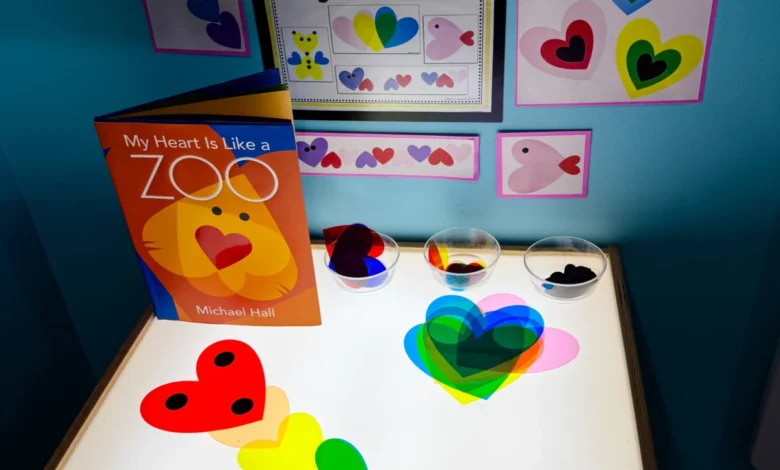
The soft ambient glow of the light table has long remained a cornerstone of early childhood education, serving as an adaptable hub that educators can seamlessly tailor to changing seasonal themes, academic units, and holidays. Among the most popular iterations of this sensory tool is the heart art light table activity, a low-preparation, high-impact lesson plan frequently deployed in preschools and kindergarten classrooms leading up to Valentine’s Day or during geometry and shape review units. Designed to merge tactile art with foundational cognitive development, the glowing workspace invites students to arrange translucent colored shapes, fostering sustained concentration, collaborative social play, and critical early math and science skills without the barrier of complex instructional setup.

Main Facts and Classroom Implementation
The heart art activity operates on a minimalist framework that appeals to busy educators seeking high engagement with minimal prep time. The exercise requires only three core components: a functioning classroom light table, a set of translucent colored plastic or acrylic heart shapes in varying sizes, and occasionally transparent contact paper or loose parts depending on the specific variation of the collage. Teachers simply switch on the illumination surface, scatter or present the materials neatly, and allow children to guide their own exploratory play.
Educational experts note that the beauty of light table activities lies in their open-ended nature. Unlike rigid worksheet-based tasks, the illuminated surface transforms flat manipulatives into vibrant, glowing visual elements. Children naturally gravitate toward the sensory feedback of the light, which enhances focus and extends attention spans. As students handle the geometric cutouts, they actively participate in fine-motor skill enhancement, manipulating delicate pieces, positioning them precisely, and negotiating space on the light board either individually or in small groups.

Chronology and Pedagogical Integration
The integration of light tables into modern early childhood curricula has evolved over the past several decades, transitioning from specialized therapeutic tools into mainstream pedagogical instruments inspired by the Reggio Emilia approach. This educational philosophy emphasizes the environment as the "third teacher," where light, shadow, and reflection are utilized to provoke curiosity and inquiry.
In a typical daily classroom schedule, the light table center is introduced during morning free-choice station rotations.

- Phase One (Setup): Educators inspect and sanitize the light table surface, ensuring optimal electrical safety and brightness levels before arranging the translucent heart shapes by size and color.
- Phase Two (Exploration): Students enter the center and begin unstructured manipulation, testing how the light passes through different thicknesses of plastic and observing the immediate visual feedback of placing shapes onto the luminous board.
- Phase Three (Creation and Experimentation): As play progresses from individual sorting to collaborative design, children intentionally overlap pieces to construct complex mosaics, mandalas, or symmetrical patterns.
- Phase Four (Reflection and Cleanup): Educators engage students in discussions about their artwork, prompting them to articulate their design choices, identify colors, and categorize shapes before sorting the materials back into designated storage bins.
Supporting Data and Developmental Metrics
Early childhood development research consistently highlights the importance of multisensory learning environments in building neural pathways associated with spatial reasoning and abstract thinking. According to data from early education studies, children who regularly engage with light-based manipulative centers demonstrate accelerated proficiency in visual discrimination and sorting tasks compared to peers restricted to traditional two-dimensional mediums.
- Size Recognition and Geometry: By sorting hearts ranging from miniature cutouts to large-scale templates, children practice seriation—the ability to logical order items by quantitative dimensions such as length, weight, or size. This tactile geometry directly supports foundational math standards.
- Color Theory and Physics: Translucent manipulatives introduce students to primary and secondary color theory organically. When a translucent yellow heart overlaps a cyan or blue heart on the illuminated glass, children witness firsthand the subtractive or additive properties of light as a green hue emerges.
- Fine Motor Control: Pinching, grasping, and precise placement of lightweight acrylic pieces refine the intrinsic hand muscles and pincer grasp necessary for future writing proficiency.
Stakeholder Perspectives and Expert Reactions
Early childhood educators and developmental psychologists have widely endorsed light table centers for their unique ability to foster both independent concentration and social-emotional growth.

Dr. Elena Vance, a professor of early childhood education and child development, emphasizes the socio-emotional value embedded within these seemingly simple art stations. "When children gather around a light table, the physical boundaries of the glowing surface naturally draw them together," Dr. Vance observes. "Unlike crowded tables where children might work in isolation, the illuminated center encourages cooperative negotiation. They share materials, discuss overlapping colors, and build narrative language around their collaborative designs in a calm, focused environment."
Classroom teachers frequently report that the ambient, focused light has a calming neurological effect on young learners. In busy, high-stimulation preschool environments, the light table acts as a quiet oasis where children experiencing sensory overload can self-regulate while remaining deeply engaged in meaningful cognitive work. School administrators also favor the activity for its cost-effectiveness and adaptability, noting that a single set of translucent shapes can be repurposed across numerous curriculum units throughout the academic year.

Broader Impact and Implications for Early Learning
The sustained popularity of activities like the heart art light table center underscores a broader shift in early education toward play-based, inquiry-driven instruction. As educational standards increasingly emphasize STEM (Science, Technology, Engineering, and Math) competencies even at the preschool level, educators are tasked with introducing complex scientific and mathematical concepts in developmentally appropriate ways.
By grounding concepts like optics, geometry, and color blending in tactile, artistic play, the light table bridges the gap between abstract academic theory and tangible childhood experience. It demonstrates that rigorous learning does not require expensive technology or complicated lesson plans; rather, it can flourish in the gentle intersection of curiosity, collaboration, and a little bit of light.