Transforming the Classroom: How Valentine’s Day Post Office Centers Are Revolutionizing Early Childhood Education

There is a distinct, enduring magic associated with receiving a physical piece of mail in an era increasingly dominated by digital communication. For young learners in preschool and pre-kindergarten classrooms, this tangible connection is being harnessed to foster critical developmental milestones. Educators across the country are transforming traditional dramatic play areas into fully functional, Valentine’s Day-themed post offices. This innovative pedagogical approach blends imaginative play with foundational literacy, fine motor skill development, and social-emotional learning, proving that children can master complex cognitive concepts while deeply engaged in play.
Background Context and Educational Framework
Early childhood education experts have long championed dramatic play as a cornerstone of cognitive and social development. According to developmental psychologists, imaginative play allows children to process real-world scenarios, practice communication, and negotiate social hierarchies. Integrating a structured literacy component—such as a postal system—into these environments elevates standard play into an active learning laboratory.
Historically, early childhood curricula treated writing and reading as static, desk-bound tasks. However, contemporary educational standards emphasize contextual learning. By embedding writing materials, mailboxes, and communication channels directly into a festive framework like Valentine’s Day, educators capitalize on children’s natural enthusiasm for the February holiday. Preschoolers are intrinsically motivated to create cards and letters for their peers, family members, and teachers, turning the mechanics of writing from an exercise into a meaningful act of kindness.

Setting Up the Classroom Postal Infrastructure
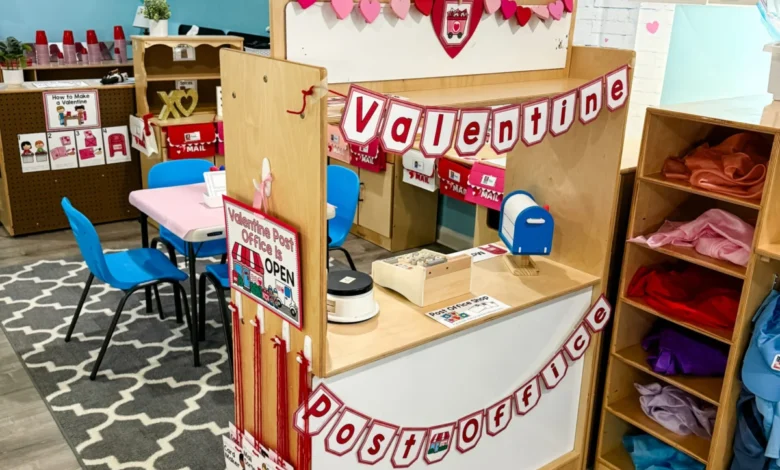
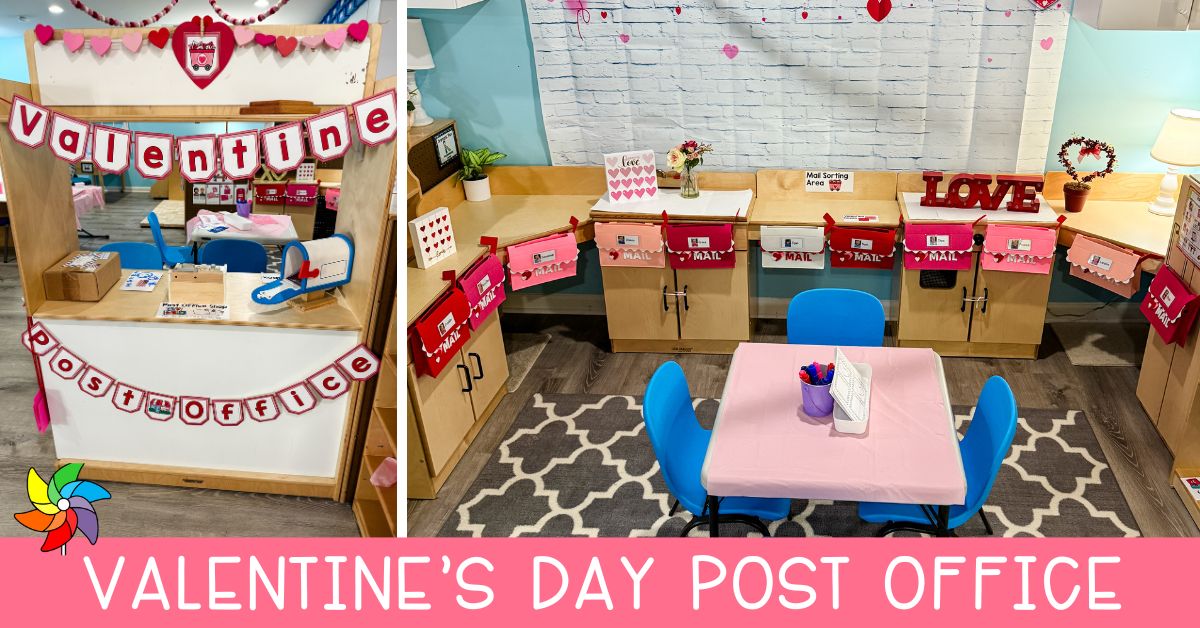
Implementing a classroom post office requires strategic spatial design and careful resource allocation. Educators typically repurpose existing fixtures within the room, transforming play kitchen counters, dining tables, or puppet theaters into official mail counters and sales windows.
To maximize educational efficacy, the setup is generally divided into two distinct zones: the sales and sorting counter and the individual mailbox station.

The sales counter serves as the hub of economic and transactional play. Here, students interact with props such as play currency, scales, stamps, stickers, and pre-cut envelopes. Items are meticulously organized into labeled baskets featuring both text and corresponding imagery. This technique, known in education as environmental print exposure, reinforces word recognition and visual literacy. An "Open/Closed" sign is frequently added to introduce basic time concepts and customer service etiquette.
Adjacent to the counter is the mailbox station. Each student is assigned a personal mailbox, identified by both their printed name and a photograph. This ensures that even non-reading preschoolers can successfully identify and retrieve mail intended for them. Seasonal backdrops and affordable dollar-store decorations help immerse the children in the thematic experience, creating an inviting atmosphere that encourages repeated visits throughout the weeks leading up to February 14th.

Chronology of the Postal Play Experience
To ensure a seamless and enriching classroom experience, educators typically introduce the postal center through a structured, multi-phase timeline over several weeks.
Phase 1: Introduction and Role Assignment
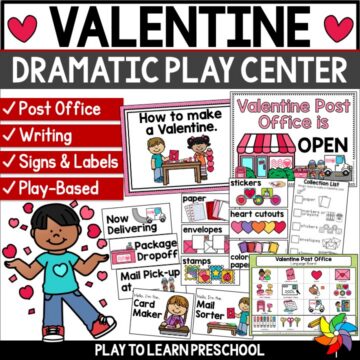
Before the post office opens to independent play, teachers lead introductory sessions to define the various roles within a postal system. Using visual aids and interactive lanyards, students learn the specific responsibilities associated with different jobs:

- The Customer: Drafts the message, places it in an envelope, acquires a stamp at the sales counter, and dispatches the letter.
- The Cashier: Manages the sales window, dispenses stamps and stickers, and collects outgoing mail.
- The Mail Sorter: Organizes incoming correspondence by recipient name or mailbox number, exercising early sorting and classification skills.
- The Mail Carrier: Delivers sorted mail directly to individual boxes or makes special deliveries throughout the classroom.
Educational specialists note that assigning these roles explicitly helps children understand community infrastructure, division of labor, and sequential processing.
Phase 2: Writing Around the Room
Simultaneously, educators establish satellite writing stations throughout the classroom to maintain momentum. A dedicated "Card Making Station" supplies folded cardstock, markers, crayons, and stickers, empowering students to author their own greetings.

To bridge the gap between imagination and literacy, classrooms often feature a Valentine’s Day language board. This visual reference assists students with spelling classmate names and high-frequency words. Additionally, step-by-step visual sequence charts guide children through the multi-stage process of creating, addressing, and mailing a card, reinforcing executive functioning and task planning.
Phase 3: Fine Motor Integration and Design
As the project progresses, teachers introduce specialized extension activities. A popular station challenges students to design their own custom postage stamps. This task requires precision, bilateral hand coordination, and fine motor control. Furthermore, students utilize picture-supported checklists to inventory their supplies or compile lists of classmates to whom they wish to send letters, seamlessly integrating early literacy into daily play routines.

Broader Impact and Real-World Implications
Data from early childhood intervention programs consistently indicate that play-based learning environments yield significant gains in both expressive and receptive language skills. When children negotiate who gets to play the mail carrier, practice writing their peers’ names, and sort items by category, they are simultaneously developing foundational skills in mathematics, spatial reasoning, and social pragmatics.
Furthermore, many preschools extend this classroom exercise into the surrounding community. In lieu of traditional field trips, which can be logistically challenging for very young children, classes frequently organize a walking excursion to a local, real-world mailbox. Students carry handcrafted valentines addressed to family members and deposit them into an authentic postal collection box. This tangible connection between the classroom simulation and civic life reinforces the value of community helpers while giving families a cherished memento.
Expert Analysis and Future Outlook
Educational analysts view thematic dramatic play centers as a vital antidote to increasingly screen-reliant lifestyles. By prioritizing tactile, interpersonal experiences, early childhood programs cultivate empathy, patience, and cooperative problem-solving—skills that cannot be replicated through digital applications.
As schools continue to refine their curricula to balance academic rigor with socio-emotional development, initiatives like the Valentine’s Day post office demonstrate that purposeful play remains the most effective vehicle for early childhood learning. By turning the simple act of sending a letter into an immersive community experience, educators are laying the groundwork for a lifelong love of literacy and civic engagement.
Related posts: