The Timeless Appeal of Finn and Violet: A Deep Dive into January 2015’s Defining Baby Names

The selection of a name for a newborn is a significant milestone for parents, often influenced by cultural trends, phonetic appeal, and historical resonance. In January 2015, the landscape of baby naming was dominated by two distinct choices that captured the zeitgeist of the era: Finn and Violet. While these names may seem simple in their composition, they carry deep etymological roots and have been championed by influential figures in pop culture, cementing their status as modern classics. Understanding why these names rose to prominence requires an exploration of their linguistic history, their social impact, and the broader context of naming conventions that define a generation.
The Etymological Origins of Finn
The name Finn is steeped in Irish mythology and history, tracing its roots to the Old Irish name "Fionn," which translates to "fair" or "white." It is most famously associated with Fionn mac Cumhaill, the legendary hero of the Fenian Cycle in Irish mythology. As a leader of the Fianna, Fionn is remembered for his wisdom, courage, and his legendary consumption of the Salmon of Knowledge.
In contemporary usage, the name has transcended its Celtic origins to become a global favorite. Its short, punchy, single-syllable structure appeals to modern parents who favor minimalist naming styles. Linguistically, it functions as a "soft" name, devoid of harsh consonants, which has contributed to its enduring popularity across English-speaking nations. By 2015, Finn had moved from a niche cultural identifier to a mainstream staple, reflecting a broader trend of parents opting for names that feel grounded yet adventurous.

The Floral Elegance of Violet
In contrast to the adventurous spirit of Finn, Violet represents a return to botanical and vintage nomenclature. Derived from the Latin "viola," the name has been in consistent use since the Middle Ages. Its peak popularity in the early 20th century, specifically the 1900s and 1910s, mirrors the "floral" naming trend that saw names like Rose, Lily, and Daisy climb the charts.
The resurgence of Violet in the 21st century can be attributed to the "vintage revival" movement, where parents began looking toward the Victorian and Edwardian eras for inspiration. Violet carries connotations of modesty, beauty, and resilience. Unlike names that are manufactured or trendy, Violet possesses a classic sophistication that allows it to remain relevant regardless of the decade. It is a name that balances delicacy with a sense of historical gravitas, making it a perennial favorite for those seeking a name that feels both timeless and fashionable.
The Influence of Pop Culture and Celebrity
The trajectory of baby names is rarely organic; it is frequently propelled by media exposure. The popularity of Finn and Violet in early 2015 was significantly bolstered by their presence in film, television, and celebrity circles.
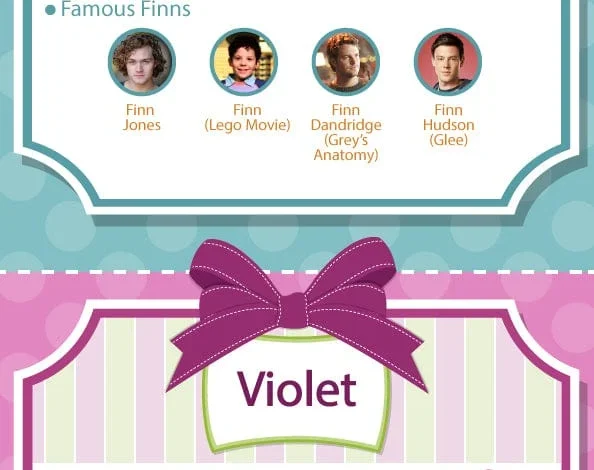
For Finn, the name gained traction through high-profile characters in popular media. The name appeared in various iterations, from the adventurous protagonist in the animated series Adventure Time to the evolving character Finn Hudson in the hit musical series Glee. These portrayals associated the name with themes of bravery, friendship, and authenticity.

Violet experienced a similar lift through celebrity choices. When high-profile entertainers and public figures choose a name for their children, it often triggers a "halo effect," causing the name to spike in popularity within social registers. Throughout the early 2010s, several high-profile births featuring the name Violet in celebrity media outlets helped transition the name from a "grandmotherly" antique to a trendy, must-have choice for the next generation.
Chronology of Naming Trends (2000–2015)
To understand the placement of Finn and Violet in January 2015, one must look at the data trends of the preceding fifteen years:
- 2000–2005: The era was dominated by traditional, biblical, and hyper-masculine names for boys, and classic, soft-sounding names for girls.
- 2006–2010: A shift occurred toward shorter, nickname-style names. "Finn" began its ascent, moving from a regional Irish favorite to a national contender in the United States and the United Kingdom.
- 2011–2014: The "Vintage Revival" fully matured. Names that were considered dusty or "old-fashioned" in the 1980s—such as Violet, Hazel, and Olive—saw a dramatic resurgence.
- January 2015: Both Finn and Violet reached a point of saturation in public consciousness, appearing frequently in birth announcements, literature, and lifestyle journals as the "it" names of the season.
Supporting Data and Statistical Trends
Statistical analysis from the Social Security Administration (SSA) and similar international bodies reveals that names like Finn and Violet are not outliers but representative of a broader movement toward shorter, more evocative names.
In 2015, the name Finn consistently ranked within the top 50 names for boys in the United States, a significant rise from its position in the late 1990s. Similarly, Violet broke into the top 50 for girls around the same time, marking a steady upward trajectory. Data indicates that parents in this era prioritized names that were easy to spell, easy to pronounce, and possessed a clear, recognizable meaning. The shift away from complex or hyphenated names toward names with fewer than three syllables—a category into which both Finn and Violet fall—was a defining characteristic of the decade.

Broader Impact and Societal Implications
The choice of a name like Finn or Violet has subtle, long-term implications. Sociologically, names are the first piece of identity a person carries. Names that are perceived as "modern classics" often avoid the stigma of being "dated," allowing the bearer to navigate both professional and personal environments with a sense of neutrality.
Furthermore, the surge in popularity for these names suggests a societal pivot toward valuing "authenticity." In an increasingly digital world, parents appear to be choosing names that evoke nature (Violet) or historical character (Finn) as a way to ground their children in something tangible and enduring.
Expert Perspectives on Naming Cycles
Linguists and sociologists specializing in onomastics—the study of names—often point to the "100-year rule." This theory suggests that names tend to cycle back into popularity after roughly a century, as the generation that last bore them passes, and younger generations rediscover them as "fresh."
Violet, having peaked in the early 1900s, perfectly followed this cycle in 2015. Finn, while newer to the global mainstream, fits the "short and strong" criteria that have dominated boy-naming trends for the last twenty years. Analysts note that as digital connectivity increases, the globalized nature of media means that a name popular in Ireland or the United Kingdom can rapidly become a favorite in North America, creating a homogenized, yet culturally rich, international naming pool.

Conclusion
The names Finn and Violet serve as perfect case studies for the intersection of history, pop culture, and social trends. While they originate from different eras and linguistic backgrounds, they converged in January 2015 to represent the quintessential naming preferences of that time. As naming conventions continue to evolve, the legacies of Finn and Violet remain secure. They are not merely fads, but rather reflective of a broader desire for names that offer a balance of historical depth and contemporary accessibility. For parents and observers alike, the study of these names offers a window into the values and aspirations of the parents who chose them, ensuring that even as trends shift in the years to come, the names Finn and Violet will continue to hold their own as pillars of modern naming culture.