Transforming the Classroom into a Valentine’s Day Post Office Boosts Early Literacy and Social Skills

Early childhood education experts have long emphasized the profound intersection between imaginative play and cognitive development. As February approaches, preschool and pre-kindergarten classrooms across the nation are increasingly adopting interactive thematic play areas to foster essential developmental milestones. Among these initiatives, the implementation of a classroom-based Valentine’s Day Post Office has emerged as a cornerstone pedagogical tool. By blending dramatic play with structured writing centers, educators are discovering innovative ways to cultivate early literacy, enhance fine motor skills, and encourage social-emotional growth in young learners.

The evolution of dramatic play in early childhood curricula traces back decades, grounded in the theories of developmental psychologists who noted that children make sense of the world through imitation and role-play. Transforming a standard classroom dramatic play area—traditionally utilized as a play kitchen or grocery store—into a functioning postal hub taps into familiar community routines. According to early childhood education specialists, structured dramatic play significantly accelerates vocabulary acquisition, narrative comprehension, and collaborative problem-solving among children aged three to five.

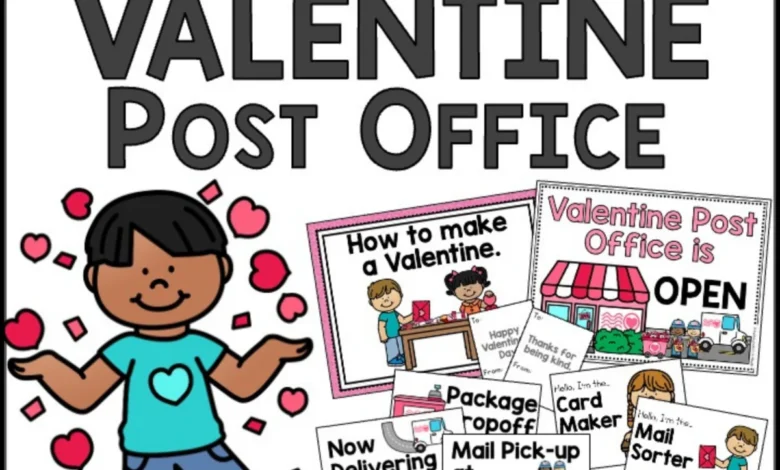
Establishing a functional classroom post office requires strategic spatial planning and resource allocation. Educators typically repurpose flat surfaces such as play kitchen counters, dining tables, or puppet theaters to serve as the main postal service desk. The physical environment is carefully segregated into distinct zones: the sales counter, the sorting station, individual student mailboxes, and peripheral writing stations.

To maximize literacy exposure, the sales counter is typically stocked with categorized baskets containing envelopes, stickers, custom-designed stamps, and writing utensils. Each container is explicitly labeled with both high-resolution photographs and environmental print. This intentional design exposes children to visual and textual signifiers, reinforcing word recognition and categorical sorting abilities. Additionally, individualized mailboxes—adorned with each student’s photograph and printed name—are installed at an accessible height to promote self-recognition, peer awareness, and spatial orientation.

Beyond the central post office counter, educators integrate satellite writing stations throughout the classroom environment to encourage sustained engagement. The Card-Making Station offers folded cardstock, crayons, and markers, inviting children to draft personalized correspondence for classmates, family members, and friends. Complementary activities, such as stamp-designing tables, challenge children to exercise their creativity while refining pencil grips and scissor manipulation.

Literacy integration is further supported through structured visual aids, including sequential instructional charts that outline the step-by-step process of mailing a letter. These visual timelines assist young learners in executive functioning, teaching them how to conceptualize a project from initiation to completion. Furthermore, thematic language boards equipped with high-frequency sight words and peer name banks empower children to independently spell messages, bridging the gap between phonetic awareness and functional writing.

Role assignment is a critical component of the postal play architecture. Educators utilize specialized lanyards to designate specific jobs within the post office, such as customer, cashier, mail sorter, and postal carrier. Prior to opening the center, teachers conduct guided discussions detailing the specific duties associated with each role. For instance, customers draft letters and purchase postage; cashiers facilitate transactions and manage supplies; mail sorters categorize incoming correspondence; and postal carriers ensure final delivery to individual mailboxes.

This structured allocation of responsibilities directly supports pre-math and pre-literacy development. Sorting mail by name or symbol reinforces classification skills, while the physical delivery of letters encourages spatial navigation and intentional movement within the classroom. Moreover, these structured interactions facilitate critical social-emotional learning objectives, including turn-taking, empathy, and positive peer communication.

In many participating schools, the classroom postal initiative extends beyond the school walls through community-integrated extension activities. To foster a real-world connection, educators frequently coordinate class walks to local United States Postal Service collection boxes, allowing students to mail actual letters or handmade cards to their families. While traditional field trips can present logistical and financial hurdles, this low-budget alternative grounds abstract classroom concepts in tangible reality. Parents consistently report positive responses to receiving authentic, child-created correspondence, reinforcing the home-school connection.

From a pedagogical standpoint, the implementation of thematic post office centers yields measurable benefits across multiple developmental domains. Educational analysts note that play-based literacy interventions significantly reduce anxiety surrounding writing tasks in later academic years. By reframing writing as a purposeful, communicative act rather than a rote exercise, children develop intrinsic motivation to master foundational mechanics.

Furthermore, the emphasis on kindness, cooperative play, and community helpers aligns with broader early learning standards aimed at fostering well-rounded social citizens. As schools continue to seek evidence-based strategies that balance academic rigor with developmental appropriateness, the classroom post office remains a enduringly effective model. By transforming an everyday postal transaction into an immersive learning laboratory, educators are successfully equipping the next generation with the communication and critical-thinking skills essential for lifelong academic achievement.