Sweet Learning: How Educators Are Transforming Conversation Hearts into Early Childhood Mathematics Tools

As the middle of February approaches, classrooms across the country routinely witness the arrival of a ubiquitous seasonal confectionery: the pastel-colored, stamped conversation heart. Long dismissed as a novelty candy with a polarizing flavor profile, these chalky sugar tablets have undergone a pedagogical renaissance. Early childhood educators and preschool specialists are increasingly leveraging conversation hearts as hands-on manipulatives to teach foundational mathematics, spatial reasoning, and fine motor skills to children aged three to six. This trend marries the engaging sensory appeal of holiday treats with structured, standards-aligned early education curricula, providing a practical framework for educators navigating the mid-winter instructional landscape.

The integration of candy into preschool classrooms is part of a broader, well-established educational methodology known as concrete-pictorial-abstract (CPA) learning. Developed by mathematician Jerome Bruner, this framework posits that young children learn most effectively by first manipulating physical objects before moving to visual representations and, eventually, abstract symbols. In the context of early math instruction, items like conversation hearts serve as accessible, low-cost counters that bridge the gap between abstract number concepts and tangible reality.
Historically, early childhood educators have relied on plastic counters, wooden blocks, and dried beans for table tasks. However, seasonal objects introduced around holidays—such as pumpkin seeds in autumn or candy hearts in February—offer a distinct advantage in student engagement. According to developmental psychologists, novelty acts as a powerful intrinsic motivator for young learners, capturing attention and reducing classroom behavioral friction during independent or small-group table work.

The implementation of these sweet math modules typically follows a structured sequence designed to build progressive competencies over the course of several days or weeks.
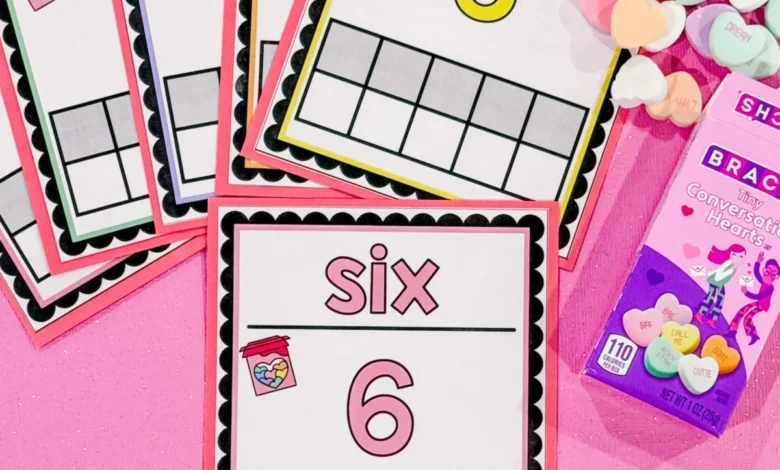
The instructional sequence usually begins with fundamental numeracy and one-to-one correspondence tasks using specialized counting mats and tens frames. During these exercises, students are presented with a numerical digit printed on a worksheet and are tasked with counting out an identical quantity of candy hearts to place within designated grid slots. This seemingly simple exercise is critical for cognitive development; it reinforces the principle that the final number counted in a set represents the total quantity of objects, regardless of their arrangement.

For advanced preschoolers and early kindergarteners, educators often extend these counting exercises into foundational arithmetic. Teachers can instruct students to consume one or two pieces of their counted set, prompting an immediate, highly visual lesson in basic subtraction.
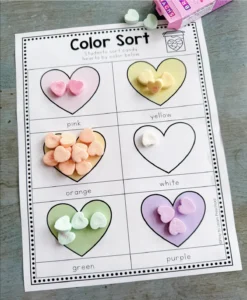
Following numerical recognition, the curriculum shifts toward classification and data organization. Color sorting mats divide the pastel candies into distinct categories—typically encompassing pink, yellow, green, purple, orange, and white. This encourages students to analyze attributes, articulate color names, and engage in comparative analysis. Instructors frequently prompt children with analytical questions: Which color group contains the highest volume? Which is the rarest? Are there perceptible variations in flavor among the different colors?

This data collection naturally segues into introductory graphing exercises. Students arrange their sorted candies vertically or horizontally on specialized grid templates. By transforming loose candy pieces into structured bar graphs, children gain their first exposure to visual data representation, learning to interpret visual height and length as indicators of quantity long before they encounter formal bar charts in upper elementary grades.
Beyond arithmetic and data, modern early childhood standards heavily emphasize pattern recognition and geometry—areas where conversation hearts prove remarkably versatile. Patterning exercises require students to analyze alternating color sequences—such as pink-yellow-pink-yellow—and determine the correct color required to complete the sequence. This cognitive task builds executive function and lays the groundwork for algebraic thinking.

In the realm of geometry, fine motor control and spatial awareness are tested through shape-tracing and nonstandard measurement tasks. Rather than using traditional plastic rulers, students stack conversation hearts vertically to measure the height of printed objects on a worksheet, subsequently recording the numerical tally. Alternatively, children outline geometric shapes—circles, squares, and triangles—by meticulously placing individual candies along the borders. This tactile exercise forces students to slow down and observe the physical properties of shapes, noting the distinct differences between the sharp angles of a triangle and the continuous curves of a circle.
The pedagogical shift toward themed, low-prep holiday activities has also spawned a commercial marketplace for digital educational resources. Educators frequently utilize downloadable curriculum bundles, such as preschool-specific Valentine’s Day activity packs, which provide standardized mats for counting, graphing, patterning, and measuring. Priced affordably for classroom teachers operating on limited budgets, these printable packets streamline lesson planning while ensuring that play-based activities remain aligned with early learning guidelines.

From an administrative and analytical perspective, the incorporation of consumable items into the curriculum reflects a broader educational philosophy that prioritizes experiential learning over rote memorization. Early childhood specialists emphasize that preschool mathematics should not feel like an intimidating academic hurdle, but rather an organic extension of play and exploration.
Child development experts note that fine motor skills—such as the pincer grasp required to pick up and place a small candy heart—are inextricably linked to future academic success, including handwriting dexterity and spatial reasoning. When a child carefully positions a candy along the curve of a heart-shaped tracing template, they are simultaneously exercising hand-eye coordination, cognitive focus, and geometric comprehension.

Critics of using candy in educational settings occasionally raise concerns regarding nutritional health and dietary restrictions, particularly in classrooms with strict wellness policies or children with food allergies. However, proactive educators easily mitigate these concerns by substituting edible items with non-edible counterparts, such as plastic heart counters, foam shapes, or laminated cutouts, while preserving the core mechanics of the lesson. Alternatively, consumption is strictly regulated as a rare, end-of-lesson reward rather than a core component of dietary intake during instructional hours.
As the educational community continues to seek innovative ways to capture student attention in an era of digital distraction, tactile, hands-on learning tools remain remarkably resilient. By transforming a simple, seasonal candy into a multifaceted instrument for counting, graphing, measuring, and geometry, teachers demonstrate that effective education does not require expensive laboratory equipment. Instead, with a dash of creativity and a box of conversation hearts, the preschool classroom becomes a vibrant laboratory for lifelong mathematical discovery.
Related posts: