Heart Art on the Light Table: Illuminating Early Childhood Education Through Sensory and STEAM Learning

Early childhood educators across the country are continually seeking innovative, low-preparation activities that seamlessly blend aesthetic engagement with foundational academic concepts. One such classroom feature capturing the attention of preschool curriculum developers is the light table. Long celebrated for its soft ambient glow and sensory appeal, the light table has evolved into a dynamic learning center adaptable to various seasonal themes, mathematical concepts, and artistic endeavors. Among the most recent pedagogical innovations gaining traction in preschool classrooms is the "Heart Art on the Light Table" activity, a multidisciplinary exercise tailored for Valentine’s Day units and geometric shape reviews. Designed to foster both individual creativity and collaborative social skills, this glowing sensory experience has demonstrated significant utility in promoting early childhood development through play-based exploration.

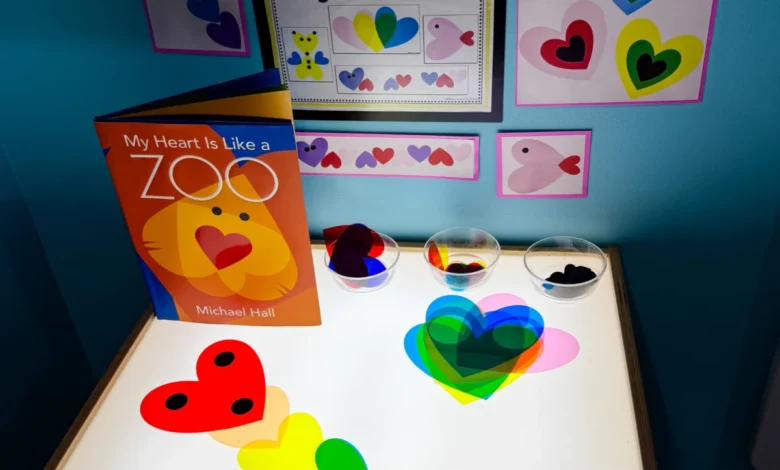
The implementation of the light table heart art activity requires minimal preparation, an asset highly valued by educators managing fast-paced classroom schedules. Standard setups typically involve a glowing light table panel accompanied by a curated selection of translucent materials, such as colored acrylic or acetate heart shapes in varying sizes. The preparation process generally spans no more than a few minutes: educators power on the light table, arrange the translucent manipulatives, and invite students to engage with the materials independently or in small groups. Despite its simplicity, the activity bridges several core developmental domains, including fine motor skill refinement, visual-spatial awareness, and early science and mathematics competencies.
To fully understand the pedagogical value of this glowing learning center, education specialists look to the broader evolution of light tables in modern classrooms. Originally utilized primarily in photographic and medical settings, light tables migrated into educational institutions during the mid-to-late 20th century as Reggio Emilia-inspired approaches gained prominence in Western early childhood education. The Reggio Emilia philosophy emphasizes the environment as the "third teacher," prioritizing spaces that invite wonder, inquiry, and aesthetic appreciation. By illuminating objects from beneath, light tables alter visual perception, heightening children’s focus and concentration. The translucent quality of the materials used on these tables allows light to pass through, creating vibrant hues and sharp contrasts that naturally draw young learners in and sustain their attention for extended periods.

From a cognitive standpoint, the heart art activity offers a practical application of foundational mathematical and scientific principles. As children select, sort, and arrange the translucent hearts, they actively practice size recognition, categorizing the objects by dimensions such as small, medium, and large. Furthermore, the activity serves as an intuitive introduction to color theory and optics. Because the heart shapes are translucent and dyed in primary and secondary colors, overlapping them on the illuminated surface causes the hues to blend, producing entirely new secondary and tertiary colors. This hands-on experimentation allows preschoolers to discover scientific concepts of light transmission and color subtraction empirically, long before encountering these topics in formal elementary science curricula.
In addition to cognitive and academic gains, early childhood development experts emphasize the critical role that light table centers play in fostering socio-emotional growth. Preschool classrooms function as vital micro-societies where children learn the complexities of sharing, negotiation, and verbal communication. Because light tables are typically designed for collaborative use by small groups of two to four students, they naturally encourage social interaction. Observations from educators utilizing the heart art center indicate that the calm, focused atmosphere of the glowing table tends to mitigate behavioral conflicts. Children routinely share materials, negotiate design choices, and articulate their creative visions to their peers. This verbalization supports expressive language development and peer-to-peer bonding, reinforcing the classroom community.

The broader implications of integrating sensory-rich, low-prep STEAM (Science, Technology, Engineering, Arts, and Mathematics) activities into early childhood settings are significant. Educational researchers point out that early exposure to open-ended, exploratory art projects builds crucial executive function skills, including working memory, mental flexibility, and self-control. When children are given the autonomy to design their own compositions using light and color, they exercise decision-making capabilities that translate to enhanced problem-solving skills in later academic years. The shift away from rigid, worksheet-based instruction toward experiential learning environments like the light table reflects a broader modernization of early childhood education standards nationwide.
As school districts and independent preschool programs continue to refine their curricula to meet holistic development benchmarks, activities that combine aesthetic engagement with cross-curricular learning will remain a staple of modern pedagogy. The success of the light table heart art center underscores a fundamental truth of early childhood education: profound learning rarely requires overly complex apparatuses. Often, the most impactful educational experiences arise from the simplest intersections of light, material, and unguided human curiosity.
Related posts: