The Lexicon of Childhood: How Toddler Mispronunciations Shape Family Culture and Linguistic Evolution

The domestic household remains the primary incubator for spontaneous linguistic innovation, where the phonetic interpretations of young children frequently give rise to enduring familial dialects. Across generations, parents have documented the creative vocabulary of toddlers—transforming conventional semantics into idiosyncratic family lexicons. While these linguistic deviations are temporary byproducts of cognitive and physiological development, their cultural footprint within family units often spans decades, persisting long after children have reached adulthood. This phenomenon has increasingly drawn the attention of developmental psychologists, linguists, and sociologists, who view childhood word formation not merely as errors to be corrected, but as a fascinating intersection of cognitive processing, phonetic limitation, and affectionate family bonding.
Cognitive Foundations and Phonological Development
The genesis of childhood mispronunciations lies in the complex mechanics of language acquisition. Between the ages of one and five, children undergo a period of explosive vocabulary growth, mapping new words at a rate that far outpaces their physiological ability to articulate complex phonemes. According to developmental speech data, young children frequently simplify intricate consonant clusters, substitute difficult sounds with familiar ones—a process known as phonological substitution—or create logical morphological extensions based on the rules they have thus far internalized.
For instance, when a toddler refers to a helicopter as a hop-dinger, a stethoscope as a hefascope, or a lawnmower as a mow-lawner, they are applying creative synthesis to unfamiliar concepts. Similarly, grammatical over-regularization—such as generating formations like willn’t, uncorrect, or runned—demonstrates a rigorous, albeit premature, application of structural logic to the English language. Children recognize patterns in syntax and morphology, such as adding "-ed" for past tense or creating contractions, and apply them universally before encountering irregular exceptions.
Speech and language pathology frameworks emphasize that these transitional phases are critical components of literacy and neurological development. Rather than indicating a deficiency, these semantic adaptations reflect an active, exploratory engagement with communication. Children are not simply mimicking adult speech; they are actively constructing a mental framework for how language operates.
The Parental Dilemma: To Correct or to Savor
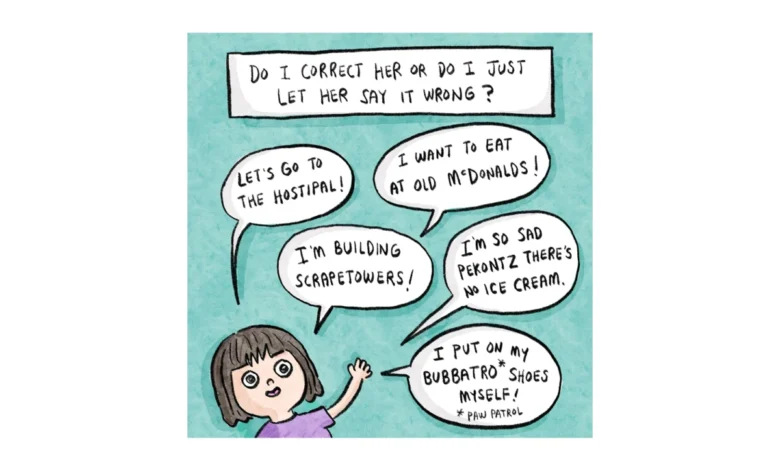
A central debate among parents and linguistic scholars involves the appropriate response to childhood malapropisms. Traditional pedagogical approaches often prioritized immediate correction to accelerate standard language mastery. However, contemporary sociolinguistic advice increasingly encourages caregivers to embrace, record, and even adopt these creative expressions.
Many families maintain running digital notes or physical journals dedicated entirely to preserving these linguistic anomalies. Terms such as salamami for salami, sky-screamer for sunscreen, or old outch for commercial potato chip brands frequently transition from temporary errors to permanent household terminology. In many cases, these words outlive the childhood stage entirely, persisting as private family code words well after the children have entered middle school, high school, or adulthood.
Linguists argue that heavy-handed correction can inadvertently stifle a child’s willingness to experiment with expressive language. By prioritizing natural modeling—repeating a word correctly within a conversational response rather than overtly rebuking the child—parents can support proper phonetic development while preserving the playful spontaneity that characterizes early childhood communication.
Chronology of Linguistic Evolution within the Household
The lifecycle of household slang follows a distinct, albeit informal, chronology that mirrors the developmental milestones of growing children. Understanding this timeline provides context for how temporary vocal quirks become permanent cultural touchstones within family units:
- Initial Emergence (Ages 1 to 2.5): The onset of expressive language features heavy phonetic simplification, characterized by substitutions like goh-guh for water or coco for shoes. At this stage, communication relies heavily on immediate needs and sensory associations.
- Creative Synthesis and Morphological Logic (Ages 2.5 to 4): Children begin combining known concepts to describe novel phenomena, producing terms such as mystery hooks for question marks, baby buttons for belly buttons, or chocolate Jesus for standard religious lyrical interpretations.
- Institutional Collision (Ages 5 to 7): The entry into formal schooling introduces children to standardized phonetics and peer review. This phase often brings sudden realizations, humorous classroom corrections, and the bittersweet transition from toddler vocabulary to formal academic language.
- Retention and Heritage Adoption (Ages 8 and Beyond): While children generally self-correct or adopt standard regional dialects by late childhood, families frequently retain selected terms as nostalgic inside jokes, creating a dual-layered domestic lexicon that bridges childhood memory with adult nostalgia.
Sociological and Psychological Implications
Beyond the immediate charm of domestic humor, childhood language creation offers significant insight into the psychological bonding of family units. Shared insider terminology functions as a social glue, reinforcing group identity and collective memory. When adults continue to use terms like hot sticks for French fries or skabetti for spaghetti decades later, they are invoking a shared narrative history that transcends literal communication.
Furthermore, these linguistic phenomena highlight the fluidity of language on a broader scale. Standard languages are not static monuments; they are aggregate systems born from historical shifts, mispronunciations, and cultural mixing. The whimsical coinages generated by toddlers—such as terriscared or art stein—serve as micro-level examples of how new linguistic forms organically enter human expression.
Ultimately, the phenomenon of childhood malapropisms bridges the gap between developmental science and human affection. As children navigate the labyrinth of human speech, their missteps provide moments of levity, creativity, and profound connection, reminding families that language is not merely a tool for functional exchange, but a canvas for shared imagination.
Related posts: