Certification in Early Childhood Education: A Comprehensive Guide to Professional Pathways and Industry Standards


Early childhood education (ECE) represents a critical pillar of the global educational infrastructure, focusing on the developmental window from birth through approximately age eight. This period is widely recognized by neuroscientists and developmental psychologists as the most significant phase of human brain development, during which the foundations for cognitive, social, and emotional intelligence are established. As the demand for high-quality childcare and preschool programs continues to rise, the professionalization of the workforce through formal certification has become a primary focus for policymakers, educational institutions, and advocacy groups. Certification serves as a standardized benchmark, ensuring that practitioners possess the specialized knowledge required to foster healthy development and navigate the complexities of modern early learning environments.
The Evolution and Current Landscape of Early Childhood Education
The field of early childhood education has undergone a significant transformation over the last three decades. Historically viewed as "childcare" or "babysitting," the sector has shifted toward a research-based pedagogical approach. This evolution is driven by longitudinal studies, such as the HighScope Perry Preschool Project and the Abecedarian Project, which demonstrated that children who receive high-quality early education are more likely to achieve higher academic performance, better health outcomes, and greater economic stability in adulthood.
Today, the ECE sector is characterized by a push for "universal pre-K" in many jurisdictions and a rigorous emphasis on teacher qualifications. According to the U.S. Bureau of Labor Statistics (BLS), employment for preschool teachers is projected to grow steadily through 2032, driven by a continued emphasis on early childhood education as a prerequisite for later academic success. However, this growth coincides with a national conversation regarding the "professionalization gap"—the disparity between the high level of skill required for the role and the historically lower compensation rates compared to K-12 educators.
A Chronology of the Certification Process
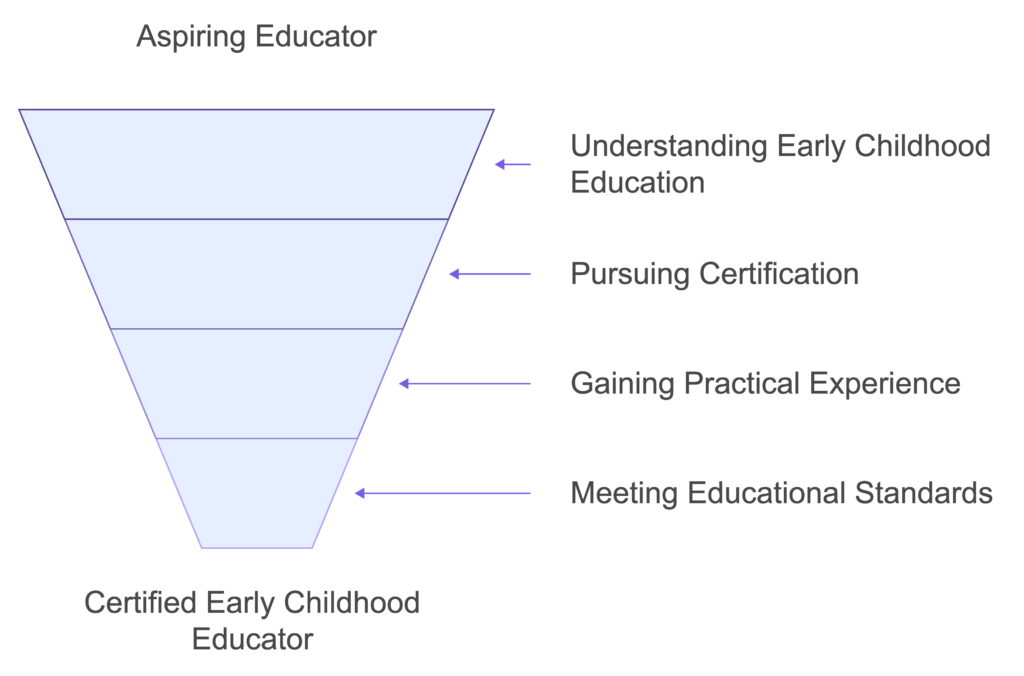
The journey toward becoming a certified early childhood educator is a multi-stage process that balances theoretical academic study with hands-on clinical experience. While specific requirements vary by state and country, the professional path generally follows a standardized chronology:
- Initial Goal Alignment and Path Selection: Candidates must first determine their desired work environment. Those aiming for private childcare or Head Start programs often pursue the Child Development Associate (CDA) credential. Those seeking to teach in public school systems typically require a state-issued teaching license, which necessitates a minimum of a bachelor’s degree.
- Academic Enrollment and Core Coursework: Educational programs focus on the science of child development. Key modules include "Cognitive Development in Early Childhood," "Language and Literacy Acquisition," and "Inclusive Classroom Management." These courses provide the theoretical framework for understanding how children process information and interact with their peers.
- Supervised Practicum and Fieldwork: Before certification, candidates must complete a designated number of hours—often ranging from 480 to 600—in a classroom setting. This phase is critical for translating theory into practice under the mentorship of experienced educators.
- Formal Assessment and Examination: Candidates must pass standardized exams, such as the Praxis Series or specific state-level certification tests. For the CDA, this involves a "Verification Visit" by a Council Representative and the submission of a comprehensive professional portfolio.
- Credential Issuance and Licensure: Upon successful completion of all requirements, the candidate applies to the relevant state board or national council for their formal credentials.
Diverse Pathways to Professional Certification
There is no singular route to becoming an ECE professional; rather, there are multiple tiers of certification designed to accommodate different career goals and educational backgrounds.
The Child Development Associate (CDA) Credential
The CDA is the most widely recognized national credential in early childhood education. It is an entry-level certification that focuses on the core competencies of educators in center-based, home-based, or visiting programs. It requires 120 hours of formal professional education and 480 hours of experience working with children.

Associate and Bachelor’s Degrees
An Associate of Arts (AA) or Associate of Science (AS) in Early Childhood Education provides a more robust academic foundation, often serving as a stepping stone to a four-year degree. A Bachelor’s degree (BA or BS) is increasingly becoming the standard for lead teachers in high-quality programs. Many states now mandate that lead teachers in state-funded pre-K programs hold a bachelor’s degree in ECE or a related field.
State-Level Teaching Certification
For educators who wish to work within the public school system (grades Pre-K through 3rd), a state-specific teaching license is required. This involves completing a state-approved teacher preparation program, passing background checks, and clearing rigorous subject-matter examinations.
Core Competencies and Pedagogical Requirements
Certification is more than a legal requirement; it is a validation of specific professional competencies. Certified educators are trained to implement curricula that are developmentally appropriate, culturally responsive, and inclusive of children with diverse learning needs.
- Advanced Observation and Documentation: Professional educators are trained to use observation as a diagnostic tool. By documenting a child’s progress through anecdotal records and portfolios, teachers can tailor their instruction to meet individual developmental milestones.
- Creative Curriculum Design: Certified teachers do not just follow a manual; they design learning environments. This involves "scaffolding"—a technique where teachers provide temporary support to help a child reach a higher level of understanding than they could achieve alone.
- Emotional Intelligence and Empathy: The ability to regulate one’s own emotions while helping young children navigate theirs is a core professional skill. Certified educators study "Social-Emotional Learning" (SEL) to help children develop resilience and self-regulation.
- Stakeholder Collaboration: A significant portion of ECE training involves learning how to communicate with families. Certified professionals act as a bridge between the classroom and the home, ensuring that a child’s development is supported in both environments.
Industry Data and Economic Implications
The economic impact of the early childhood education sector is profound. Data from the Economic Policy Institute (EPI) suggests that investment in high-quality ECE provides a high return on investment (ROI), with some estimates suggesting a $7 to $13 return for every $1 invested, primarily through reduced special education costs, lower crime rates, and higher tax contributions from earners who had a strong educational start.
However, the industry faces a significant labor challenge. Despite the rigorous certification requirements, the median hourly wage for childcare workers remains lower than that of many other sectors requiring similar levels of training. This has led to a high turnover rate within the industry. Professional organizations like the National Association for the Education of Young Children (NAEYC) are actively lobbying for "compensation parity," arguing that if educators are held to high professional standards through certification, their compensation should reflect that expertise.
Broader Impact and Global Perspectives
The push for certification is a global trend. Organizations such as UNESCO and UNICEF have identified early childhood education as a key factor in achieving sustainable development goals. In many European nations, early childhood educators are required to hold university-level degrees, resulting in higher societal prestige and better outcomes for children.
In the United States, the "Power to the Profession" initiative—a collaborative effort of 15 national organizations—is working to define a unified framework for the ECE profession. This framework aims to standardize the various certification paths and ensure that every child, regardless of their socio-economic background, has access to an educator who has been vetted through a rigorous professional certification process.
The Role of Continuing Professional Development
Certification is not the end of an educator’s training but rather the beginning of a lifelong professional commitment. Most certifying bodies require educators to complete "Clock Hours" or Continuing Education Units (CEUs) every few years to renew their credentials. This ensures that practitioners remain current with the latest research in brain science, trauma-informed care, and educational technology.
As the field moves forward, new certifications are emerging in specialized areas, such as Early Childhood Special Education, English as a Second Language (ESL) for young learners, and STEM integration in early childhood. These micro-credentials allow educators to further refine their skills and meet the specific needs of their communities.
Analysis of Future Implications
The future of early childhood education will likely see a continued tightening of certification standards. As research continues to highlight the "achievement gap" that often begins before a child even enters kindergarten, the pressure on ECE professionals to deliver measurable results will increase. While this adds stress to the workforce, it also elevates the status of the educator.
A certified early childhood educator is no longer seen as a "helper" but as a specialized professional who is instrumental in shaping the future of society. The certification process, while demanding, provides the necessary infrastructure to support this high-stakes work. By ensuring that educators are grounded in developmental science and ethical practice, certification protects the interests of children, provides peace of mind to parents, and strengthens the educational fabric of the nation.
In conclusion, the path to certification in early childhood education is a rigorous journey that reflects the immense responsibility of the role. It requires a unique blend of academic mastery, practical skill, and a deep-seated commitment to the well-being of the youngest members of society. As the industry continues to evolve, the certified educator will remain at the heart of the effort to provide every child with a foundation for a successful and fulfilling life.