The Evolution of Light-Based Pedagogy in Early Childhood
The use of light as an educational medium traces its roots back to the Reggio Emilia approach, an educational philosophy focused on preschool and primary education that originated in Italy after World War II. This philosophy views the environment as the "third teacher," emphasizing the importance of aesthetics and sensory exploration. The light table, or "tavolo luminoso," was originally designed to allow children to investigate the properties of materials—transparency, opacity, and vibrancy—in a way that standard desk-top activities could not provide.
In the contemporary American preschool system, the light table has transitioned from a niche specialized tool to a standard fixture. According to data from the National Association for the Education of Young Children (NAEYC), sensory play is a critical component of brain development in children aged three to five. It builds nerve connections in the brain’s pathways, which lead to the child’s ability to complete more complex learning tasks. The Heart Art activity represents a strategic application of these principles, aligning with current educational standards that prioritize hands-on, inquiry-based learning over passive instruction.
Technical Requirements and Procedural Implementation
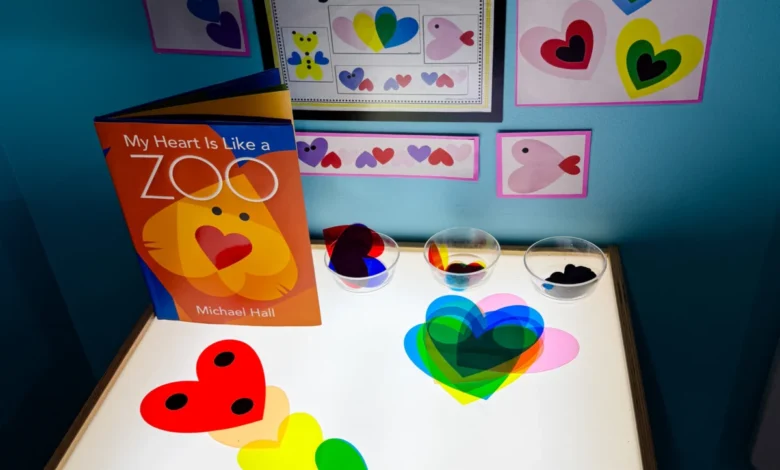
The Heart Art on the Light Table activity is characterized by its logistical simplicity, which belies its significant educational depth. Implementing the center requires three primary components: a standard classroom light table or light panel, translucent plastic hearts in varying sizes and colors, and clear transparency sheets or a protective surface.

The procedural timeline for establishing this learning center follows a structured three-step sequence. First, the educator prepares the light table by ensuring a clean, stable surface, often placing a clear transparency sheet over the light source to protect the equipment from scratches or adhesive residue. Second, a curated selection of translucent hearts is introduced. These hearts are typically manufactured from acrylic or thin plastic, allowing light to pass through and illuminate the pigment. Third, the light source is activated, creating an ambient glow that serves as a visual "invitation to play."
Once the center is established, the instructional phase begins. Educators act as facilitators rather than directors, allowing students to lead the exploration. This "open-ended play" model is essential for fostering creativity, as it removes the pressure of a "correct" outcome, focusing instead on the process of discovery.
Cognitive and Developmental Milestones
The Heart Art activity serves as a vehicle for several key developmental milestones. While the students perceive the activity as a creative endeavor, they are simultaneously engaging in complex cognitive processing.
Size and Shape Recognition
By interacting with hearts of varying dimensions, students practice visual discrimination. They must identify, sort, and categorize the shapes, which is a foundational skill for early mathematics. Recognizing that a small heart can fit inside a larger heart, or that three small hearts can span the width of one large heart, introduces the concepts of spatial awareness and geometry.

Advanced Color Theory and Light Physics
The most significant scientific takeaway from this activity involves color theory. Because the materials are translucent, they demonstrate the principles of subtractive color mixing. When a blue heart is placed over a yellow heart on the light table, the intersection appears green. This immediate visual feedback allows preschoolers to experiment with cause and effect. They learn that the intensity of the light affects the vibrancy of the colors, providing an introductory lesson in the physics of light and optics.
Fine Motor Refinement
The physical act of picking up, rotating, and placing thin plastic hearts requires high-level fine motor coordination. Strengthening the small muscles in the hands and fingers is a prerequisite for handwriting and other academic tasks. The light table environment encourages a high degree of focus, often leading children to spend extended periods refining their placements, which builds stamina for concentrated tasks.
Social-Emotional Learning and Collaborative Discovery
Beyond the cognitive benefits, the light table serves as a hub for social-emotional development (SED). Unlike individual desk work, the light table is typically a shared space, accommodating two to four students at a time. This proximity necessitates the use of social skills such as turn-taking, sharing of materials, and verbal negotiation.
Observations from early childhood specialists indicate that the soft, ambient glow of the light table often has a calming effect on classroom dynamics. In an environment that can sometimes be loud or overstimulating, the light table provides a "quiet zone" where students can engage in parallel or cooperative play.

Language development is also a natural byproduct of the Heart Art activity. As students work, they often narrate their actions or describe their "masterpieces" to peers. This builds vocabulary—using words like "transparent," "overlap," "vibrant," and "glowing"—and strengthens the ability to communicate abstract ideas. In many classroom settings, teachers have reported that even students who are typically reserved or are English Language Learners (ELL) feel more comfortable engaging in dialogue while focused on the shared visual task of the light table.
Data on Educational Outcomes
While specific longitudinal studies on "Heart Art" are limited, broader research into sensory-based STEM (Science, Technology, Engineering, and Mathematics) activities in preschool shows a strong correlation with future academic success. A 2022 report on early childhood education trends noted that students who were exposed to regular "inquiry-based sensory play" scored 15% higher on kindergarten readiness assessments in the areas of logic and reasoning compared to those in traditional curriculum-heavy environments.
Furthermore, the "visual-spatial" skills developed at the light table are directly linked to later success in reading and mathematics. The ability to visualize how shapes fit together and how colors change based on layering is a precursor to understanding symbolic representation in literacy and numerical operations.
Broader Implications for Modern Education
The success of activities like Heart Art on the Light Table reflects a broader shift in the educational landscape toward "STEAM" (Science, Technology, Engineering, Arts, and Mathematics). By integrating art with the science of light and the mathematics of shapes, educators are breaking down the silos that once separated these subjects.

This approach also addresses the "digital native" reality of modern children. Today’s preschoolers are accustomed to backlit screens and high-definition visuals. The light table bridges the gap between the tactile, physical world and the illuminated world of digital interfaces. It teaches children that they can manipulate light and color in a physical space, providing a grounding experience that balances their time spent with tablets and computers.
In terms of inclusivity, the light table is a highly accessible tool. For children with certain sensory processing needs or visual impairments, the high-contrast environment provided by the light table can make it easier to see and engage with materials. The tactile nature of the hearts combined with the visual stimulation makes it an ideal medium for differentiated instruction, ensuring that students of all ability levels can participate in the Valentine’s Day-themed learning.
Conclusion: The Impact of a "Glowing Invitation"
Heart Art on the Light Table is more than a seasonal craft; it is a sophisticated educational strategy disguised as play. By utilizing a few simple materials—a light source and translucent shapes—educators create a high-impact learning environment that addresses the "whole child." From the fine motor precision required to place a heart to the social negotiation required to share the table, every aspect of the activity is designed to support developmental growth.
As educational institutions continue to refine their approach to early childhood development, the light table remains a symbol of the "third teacher" philosophy—a space where light, color, and creativity converge to spark a lifelong love of discovery. This glowing invitation to create proves that some of the most profound lessons in science, math, and social interaction begin with something as simple as a heart and a little bit of light.

The longevity of this activity in preschools across the country suggests that its value is well-recognized by the teaching community. As Valentine’s Day approaches each year, the return of the translucent hearts to the light table is not just a tradition, but a calculated educational choice that continues to yield significant dividends in student engagement and cognitive achievement.
Related posts: