Heart Art on the Light Table Illuminates Early Childhood Classrooms with Sensory and STEM Learning

The integration of light-based sensory equipment into early childhood education has expanded significantly over the past decade, shifting from a novel classroom accessory to a cornerstone of modern preschool pedagogy. Among the most popular iterations of this trend is the light table center, a glowing workstation that educators utilize across diverse seasonal themes, geographic regions, and curriculum models. Recently, early childhood specialists have highlighted a specialized iteration of this practice: the light table heart art activity. Designed primarily for Valentine’s Day units and geometric shape reviews, this low-preparation exercise merges artistic expression with foundational principles of mathematics, color theory, and collaborative social development.
Evolution and Background of Light Table Pedagogy in Early Childhood
The pedagogical use of illuminated surfaces traces its historical roots to the Reggio Emilia approach, an educational philosophy developed in Italy following the Second World War. This child-centered framework emphasizes self-directed, experiential learning in a relationship-driven environment, often utilizing the environment itself as the "third teacher." Light tables—or light boxes—were originally adopted in these progressive schools to help children explore transparency, opacity, shadow, and light refraction.

Over subsequent decades, developmental psychologists and early childhood researchers substantiated the benefits of illuminated play. Studies in tactile and visual learning indicate that contrasting light stimulates visual focus, encourages prolonged attention spans, and supports children with diverse learning needs, including those on the autism spectrum or with sensory processing differences. By illuminating materials from underneath, educators can capture a child’s natural curiosity, transforming abstract concepts—such as geometry and light physics—into tangible, hands-on experiences.
Main Facts and Implementation of the Heart Art Activity
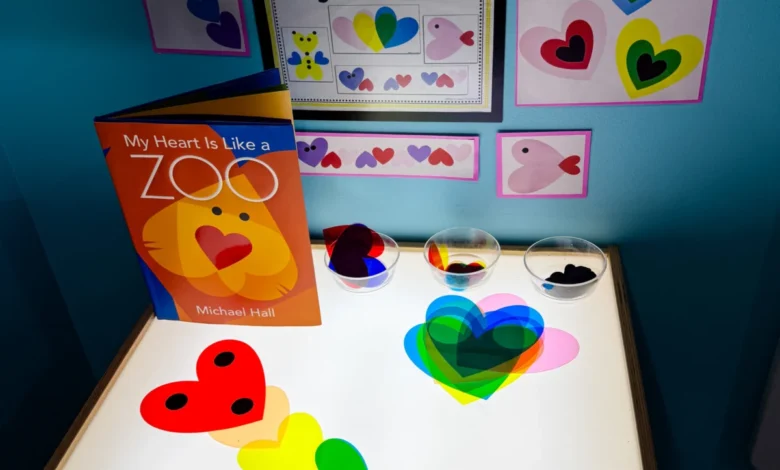
The heart art light table activity is celebrated within the education community for its accessibility and minimal preparation requirements. Designed to be implemented in preschools, kindergartens, and home-schooling environments, the center typically requires only three basic components: an illuminated light table surface, translucent colored plastic or acrylic heart shapes of varying dimensions, and occasionally supplementary loose parts such as clear rings or counting chips.
The preparation phase is intentionally streamlined to allow educators to set up the environment efficiently. Teachers generally execute a three-step preparation routine: ensuring the light table surface is clean and fully operational, sorting the translucent geometric shapes by size and chromatic spectrum, and arranging the materials in an inviting layout that encourages independent exploration. Once the power switch is flipped, the ambient glow of the table transforms the raw materials into a vibrant canvas.

From a developmental standpoint, the activity operates on multiple cognitive levels simultaneously. When children select and organize the hearts, they engage in size recognition, sorting, and spatial reasoning. As they arrange the translucent elements into layered collages, they inadvertently encounter foundational concepts of color theory. Because the plastic components are semi-transparent, overlapping a blue heart over a yellow heart creates a distinct green hue, offering children an immediate, empirical lesson in secondary color mixing.
Chronology of a Light Table Learning Session
A typical learning session at the light table follows a distinct sociological and cognitive progression, observed regularly by early childhood educators.
In the initial phase, often lasting the first few minutes after the center opens, children approach the table individually or in pairs, drawn by the visual contrast of the glowing surface. Their initial engagement is exploratory and sensorimotor; they manipulate the pieces, test how the light shines through different colors, and arrange the hearts in rows or loose piles.

As the session progresses into the middle phase, solitary exploration often transitions into cooperative play. Children begin to negotiate design choices, exchange materials, and construct elaborate visual patterns or large collaborative collages. This phase can extend from fifteen to thirty minutes, demonstrating a level of sustained focus that exceeds typical attention spans for static worksheet-based tasks.
In the final phase, children verbalize their creations, describing their geometric patterns and color combinations to peers and supervising adults. This narrative element bridges tactile creation with linguistic development, allowing children to practice descriptive vocabulary and communicative negotiation.
Supporting Data and Observational Insights
Educational research consistently underscores the efficacy of play-based, multisensory learning models in early childhood development. According to developmental metrics compiled by early childhood associations, children who regularly engage in open-ended art and sensory activities demonstrate enhanced fine motor control, improved spatial awareness, and advanced vocabulary acquisition compared to peers restricted to traditional didactic instruction.

Observations from preschool classrooms utilizing light table activities indicate that these centers naturally facilitate calm collaboration. Unlike high-velocity gross motor areas, the ambient, focused environment of the light table encourages children to moderate their vocal tones, share resources equitably, and engage in constructive peer dialogue. Educators have noted that these settings provide an ideal backdrop for children developing crucial social-emotional competencies, such as conflict resolution, empathy, and cooperative problem-solving.
Educator Perspectives and Expert Analysis
Early childhood specialists emphasize that the value of activities like the light table heart art lies in their open-ended nature. Dr. Helen Mercer, a researcher in early childhood curriculum development, notes that traditional academic drills often fail to engage young learners because they disconnect concepts from real-world sensory experiences.
"When a child places a translucent red heart over a blue heart and watches purple appear, they are not just playing; they are conducting a genuine scientific inquiry," Dr. Mercer explains. "They are generating a hypothesis, testing variables through physical manipulation, and observing the results. Furthermore, doing this alongside a peer teaches them how to articulate their observations and negotiate shared space."

Administrators and lead teachers also point out the cost-effectiveness and sustainability of such centers. Because the primary materials—translucent plastic shapes—are durable, easily sanitized, and reusable across multiple holiday themes and curriculum units, schools achieve high educational value with minimal recurrent supply expenditures.
Broader Impact and Implications for Early Learning Environments
The enduring popularity of light table activities reflects a broader shift in early education toward environments that respect children as active constructors of knowledge. By merging artistic creation with mathematical shape review and scientific inquiry, educators maximize the utility of limited classroom space and instructional time.
As schools increasingly face pressure to balance academic rigor with developmentally appropriate practices, tools like the light table offer a viable bridge. They demonstrate that rigorous cognitive concepts—such as geometry, physics of light, and color theory—do not require formal testing or sedentary instruction to be mastered. Instead, when illuminated by a simple glow and guided by curiosity, young learners can explore complex ideas organically, establishing a lifelong foundation for creative and critical thinking.