Heart Art on the Light Table Illuminates Early Childhood Classrooms with Sensory-Rich STEAM Learning

The integration of light-based sensory equipment into early childhood education has expanded significantly over the past decade, transforming traditional preschool classrooms into dynamic hubs for visual and tactile exploration. Among the various learning centers utilized by early educators, the light table remains a cornerstone of engagement due to its unique capacity to captivate young learners through ambient illumination. Recently, early childhood specialists and preschool educators have introduced a specialized seasonal module—the heart art light table activity—designed specifically to merge holiday-themed creativity with foundational mathematics and visual arts education. While initially popularized as a thematic center for Valentine’s Day and geometry reviews involving shape recognition, this minimalist, low-preparation activity has garnered widespread professional praise for its multifaceted approach to cognitive and social development in children aged three to five.

The pedagogical framework surrounding light table instruction is rooted in constructivist learning theories, which emphasize hands-on discovery and peer-to-peer collaboration. Historically, light tables were confined to clinical and specialized therapeutic settings for children with visual impairments or sensory processing differences. However, by the early 2000s, progressive preschools began adopting light-based learning tools as standard classroom inventory. Educational researchers noted that illuminating objects from beneath fundamentally alters a child’s visual perception, heightening attention spans and encouraging deeper focus. The heart art activity leverages this established psychological phenomenon by utilizing translucent colored materials that interact directly with the light source.
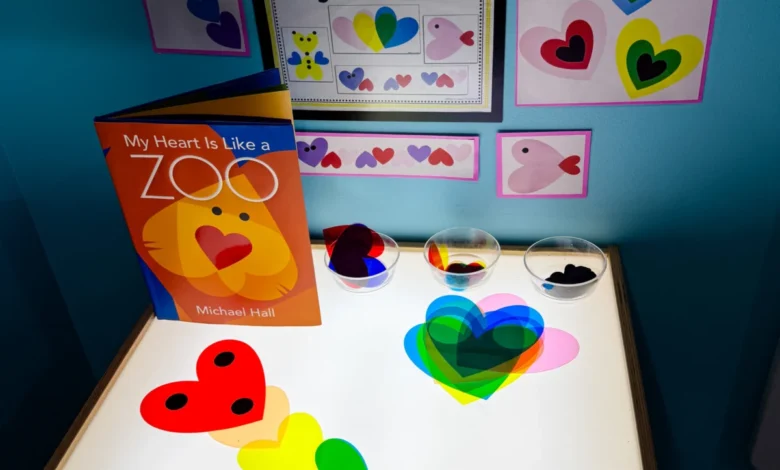
Implementing the center requires minimal logistical overhead, a factor heavily favored by preschool administrators and lead teachers striving to balance curriculum demands with preparation time. Educators require only three primary components: a functional classroom light table, a collection of translucent geometric or free-form heart shapes in varying dimensions, and a surface area or containment tray to organize the pieces. Setting up the activity typically involves three straightforward phases: inspecting and sanitizing the light table surface, arranging the sorting trays with assorted translucent hearts, and powering on the apparatus to cast an even, welcoming glow across the workspace. Despite its structural simplicity, the activity yields a dense array of learning opportunities that align with national early learning standards for mathematics, fine motor control, and visual arts.

From a developmental standpoint, the activity functions as a practical introduction to several core academic concepts. When children select and arrange the translucent hearts, they inherently engage in size discrimination and comparative measurement, distinguishing between small, medium, and large iterations of the same geometric form. Furthermore, the translucent nature of the materials introduces students to foundational color theory. As children overlap red, pink, purple, and yellow hearts upon the illuminated surface, they observe firsthand how primary and secondary colors blend to create entirely new shades, providing an empirical, sensory-driven introduction to optical science. Educational psychologists note that this form of self-directed experimentation fosters critical thinking skills, as children hypothesize outcomes and test them in real-time through artistic arrangement.
Beyond individual cognitive growth, the light table serves as an effective vehicle for social-emotional learning and collaborative communication. In typical classroom settings, the limited surface area of a light table naturally encourages small-group interaction, accommodating two to four children at a time. Observational studies conducted in preschool classrooms indicate that glowing sensory centers promote calmer, more cooperative play behaviors compared to high-energy environments like block corners or dramatic play areas. As children gather around the table, they must negotiate design choices, share limited resources, and articulate their creative intent to their peers. This dynamic encourages vocabulary expansion and narrative skills, as students describe their overlapping mosaics and geometric patterns to classmates and supervising adults.

Early childhood education experts and curriculum directors have increasingly emphasized the importance of low-prep, high-engagement centers in combating burnout among teaching staff while maximizing student autonomy. According to recent educational data compiled by early learning advocacy groups, classrooms that incorporate open-ended, sensory-based art stations report higher levels of sustained student engagement and a measurable reduction in classroom management challenges. By decoupling art from rigid templates and standardized outcomes, activities like the light table heart art project empower children to direct their own learning trajectories.
The broader implications of utilizing light-based media in preschool curricula point toward a growing recognition of STEAM (Science, Technology, Engineering, Arts, and Mathematics) principles in early education. By treating art not merely as an isolated craft project, but as an intersection of geometry, optics, and collaborative engineering, educators lay a robust foundation for future academic inquiries. As schools continue to seek innovative, cost-effective methods to enrich sensory environments, the adaptation of classic learning centers—such as illuminating simple shapes on a glowing table—demonstrates that profound educational milestones frequently stem from the most elemental materials.