Transforming Classroom Learning: How Educators Are Using Conversation Hearts to Teach Early Math and Literacy

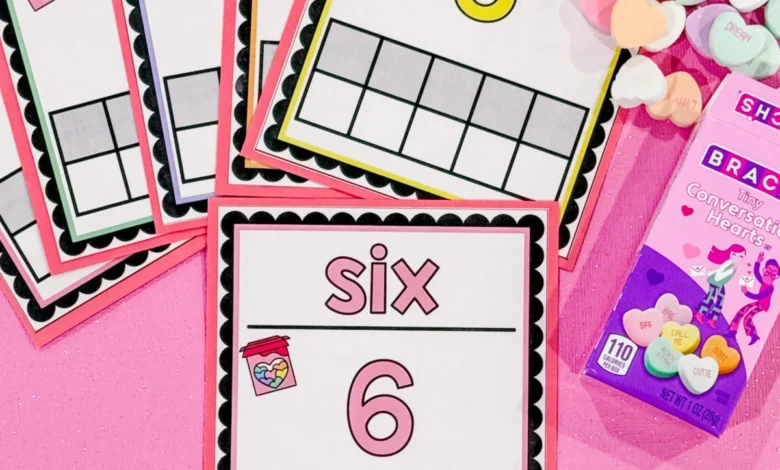
The integration of seasonal novelties into foundational education has long been recognized by early childhood specialists as a vital strategy for maintaining student engagement. As February approaches, preschool and kindergarten classrooms across the country are utilizing a ubiquitous Valentine’s Day confectionery—conversation hearts—to bridge the gap between play and academic instruction. Educators are increasingly leaning toward hands-on, multisensory approaches to teach core competencies such as early mathematics, geometry, and fine motor skills. By leveraging the bright colors, uniform size, and familiar branding of traditional candy hearts, teachers have transformed a seasonal treat into an accessible, low-prep manipulative that supports cognitive development.
Background Context and Evolution of Early Childhood Manipulatives

The use of edible or seasonal objects in American classrooms dates back several decades, mirroring the broader pedagogical shift from purely rote memorization to experiential, inquiry-based learning. Theorists such as Jean Piaget and Maria Montessori heavily influenced modern early childhood education by emphasizing that young children learn best through physical interaction with their environment. Manipulatives—objects designed to be moved and handled by students—help abstract mathematical concepts become concrete.
In the contemporary preschool classroom, teachers face the dual challenge of meeting increasingly rigorous state standards for early math and literacy while keeping activities developmentally appropriate for children aged three to five. Traditional counters, plastic cubes, and colored bears are staples of the modern classroom, but seasonal novelties offer a unique psychological advantage. The introduction of familiar holiday items sparks intrinsic motivation, curiosity, and excitement. Conversation hearts, first manufactured in their current form by the Necco company in the late 19th century and later produced by various confectioners including Brach’s, provide an ideal medium for these exercises due to their distinct color palettes and uniform dimensions.
Core Mathematical Applications: Counting, Sorting, and Graphing

At the heart of these seasonal lessons is the development of foundational numerical fluency. Educators utilize customized counting mats and tens frames to guide young learners through one-to-one correspondence—the ability to match one object to one number name. In a typical exercise, students are presented with a numerical prompt on a laminated mat and must physically place the corresponding quantity of candy hearts into designated grid spaces. This tactile process reinforces number recognition and provides an immediate mechanism for self-correction, as children can easily adjust their sets and recount if their totals do not match the prompt.
For slightly older or more advanced kindergarten students, teachers often extend these counting exercises into early subtraction. By instructing students to consume one or two pieces of their working set, educators introduce the concept of subtraction as a physical removal of quantity, laying the groundwork for more complex arithmetic.
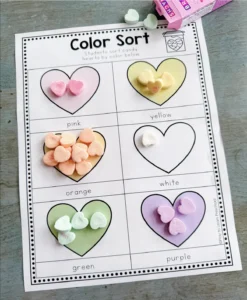
Color sorting represents another critical domain addressed through conversation heart activities. Preschool standards universally require children to identify, name, and categorize objects by visible attributes. Sorting mats divided into distinct color regions challenge students to organize a randomized pile of hearts into red, pink, purple, green, yellow, and white groups. This activity naturally transitions into introductory data analysis and graphing.

Classroom data consistently shows that children possess an innate curiosity regarding distribution and probability. When presented with a standard box of conversation hearts, students frequently question whether every box contains an identical mix of colors. Teachers capitalize on this inquiry by introducing graphing mats. Students tally and plot their findings, determining which colors appear most frequently and which are statistical outliers. This simple exercise introduces foundational statistical thinking, comparative vocabulary (such as "more than," "fewer than," and "equal to"), and scientific observation.
Patterning and Geometry: Developing Spatial Awareness
Beyond basic arithmetic, early childhood frameworks emphasize the importance of recognizing and extending patterns, as well as understanding basic geometry. Conversation hearts offer an ideal vehicle for patterning exercises due to their alternating color schemes. Students are asked to complete linear patterns—such as pink-yellow-pink-yellow—by placing the correct colored candy into the next sequence slot. Pattern recognition is widely considered by cognitive scientists to be a precursor to algebraic thinking, helping children understand predictability, logical progression, and order.

In the realm of geometry, shape-tracing activities utilize candy hearts to teach spatial boundaries and fine motor control. Instead of relying solely on pencils and paper, students place individual hearts along the outlines of printed geometric shapes, including circles, squares, rectangles, and triangles. This method forces children to slow their movements and examine the structural properties of each shape. As they navigate corners, curves, and straight lines, students build hand-eye coordination and strengthen the small muscles in their fingers and hands, which are essential prerequisites for future handwriting.
Measuring Length and Height Using Nonstandard Units
Standardized measurement systems, such as the metric or imperial systems, are developmentally premature for preschoolers who have not yet mastered abstract units like inches or centimeters. Consequently, early childhood curricula rely heavily on nonstandard measurement—using physical objects to quantify length, height, and weight.

Conversation hearts serve as effective nonstandard units of measurement. In standard classroom applications, students are given picture cards or small objects and instructed to stack candy hearts vertically or align them horizontally to match the object’s dimensions. By counting the total number of hearts required to span the length of a drawing, children learn the core principles of measurement: starting at a designated baseline, maintaining a straight line, and understanding that the last number counted represents the total magnitude. Recording these numbers on activity sheets further integrates literacy and fine motor practice into the mathematical task.
Educator Perspectives and Pedagogical Implications
Feedback from preschool and kindergarten educators regarding themed manipulative packets highlights a broader trend toward resource efficiency and holistic learning. Teachers often operate under tight budget constraints and limited preparation time, making low-prep, high-impact resources valuable.

Early childhood specialists emphasize that while sugary treats should be consumed in moderation, their intentional, structured use in academic settings does not detract from nutritional guidelines, provided portions are controlled. Instead, the multisensory nature of these activities—engaging sight, touch, and taste—creates memorable learning experiences that help cement cognitive pathways in young brains.
Analysis of Broader Educational Implications
The widespread adoption of holiday-themed academic modules reflects the changing landscape of early childhood education. Critics of modern preschool curricula often argue that classrooms have become too academic, pushing formal desk work onto children who learn best through unstructured play. However, proponents of structured manipulative-based learning argue that activities involving conversation hearts represent a middle ground. They retain the playful, imaginative spirit of early childhood while intentionally scaffolding skills necessary for later academic success.

Furthermore, integrating math, fine motor practice, and literacy into a single thematic unit addresses the diverse learning needs of modern classrooms. Children with varying attention spans and learning styles can access the same core concepts through different entry points—whether through the visual appeal of color sorting, the tactile engagement of shape tracing, or the analytical challenge of graphing.
Future Outlook for Seasonal Classroom Resources
As educational publishers continue to develop low-prep resource bundles tailored to seasonal themes, the reliance on creative manipulatives is expected to grow. Educators will likely continue seeking out familiar, cost-effective items that bridge the gap between everyday life and formal schooling. By turning ordinary holiday novelties into tools for mathematical reasoning and spatial awareness, teachers ensure that foundational learning remains both rigorous and deeply engaging for the youngest students.