Embracing Routine and Creativity: A Comprehensive Guide to February Preschool Activities

Early childhood education specialists and preschool directors across the country are reporting a distinct shift in classroom dynamics as the academic calendar turns to the shortest month of the year. February preschool activities have increasingly come to be defined by a steady, predictable rhythm that educators leverage to maximize cognitive development and social-emotional growth. By this stage in the school year, young children have fully internalized classroom routines, transitioned successfully into cooperative play patterns, and grown accustomed to the daily expectations set by their teachers.
This established familiarity significantly reduces the administrative and behavioral friction of classroom transitions. Consequently, educators find themselves with an expanded window of unstructured and semi-structured time, creating ideal conditions for extended conversations, deep sensory exploration, and repeated practice of foundational academic concepts. Rather than constantly introducing novel themes that require extensive explanation and adjustment periods, early childhood experts advocate for a curriculum model that repurposes familiar materials with subtle seasonal modifications. This pedagogical approach maintains high levels of student engagement while providing the structural consistency young learners need to thrive.

The Evolution of Early Childhood Curricula in Winter
The architectural design of a preschool day in February reflects months of careful preparation and community building. Educational psychologists note that predictability is a cornerstone of early childhood development, offering children a sense of psychological safety that directly correlates with higher engagement and reduced anxiety. When children know where materials belong, how transitions are signaled, and what behavior is expected of them, cognitive resources are freed up for higher-order tasks such as problem-solving, vocabulary acquisition, and peer negotiation.
Data compiled from early childhood education networks indicate that structured repetition during the winter months accelerates literacy and numeracy milestones. By keeping the core mechanics of learning centers consistent—such as the layout of math stations, the placement of writing implements, and the organization of sensory bins—teachers can seamlessly integrate seasonal motifs without inducing cognitive overload. In February, these motifs frequently center on themes of affection, community, meteorological observation, and collaborative play, transforming routine exercises into timely, engaging learning experiences.

Redefining Valentine’s Day Through Literacy and Communication
Historically, holiday celebrations in early childhood settings often gravitated toward elaborate craft projects and commercialized card exchanges. However, contemporary pedagogical standards emphasize communication, connection, and early literacy over product-driven art. In progressive preschool classrooms, Valentine’s Day is utilized as a thematic vehicle to foster expressive and receptive language skills.
Educators implement this by integrating thematic elements into standard literacy centers. For instance, alphabet writing cards featuring upper- and lowercase letters, paired with dry-erase markers and tactile heart-shaped manipulatives, allow children to practice fine-motor control while engaging with letters. Rhyming puzzles featuring seasonal imagery challenge auditory discrimination skills, asking children to match word families through hands-on manipulation.

According to developmental reading specialists, incorporating tactile elements into literacy instruction enhances neurological pathways associated with memory retention. When preschoolers trace letters on themed cards or sort rhyming pieces featuring seasonal icons, they are simultaneously refining their pincer grasp and reinforcing phonological awareness. This deliberate shift moves the holiday away from passive consumption and toward active, communicative skill-building.
Fostering Friendship, Empathy, and Kindness in the Classroom
Beyond academic milestones, February serves as a natural anchor point for intentional lessons on social-emotional learning (SEL). Issues of sharing, boundary-setting, and emotional regulation arise daily in preschool environments, making winter an opportune time to formally integrate kindness curricula and structured discussion circles.

Classroom observation studies show that young children benefit immensely from explicit instruction in empathy and conflict resolution. During Kindness Circle time units, educators guide students through scenarios that reflect their daily interactions, helping them articulate feelings and practice prosocial behaviors. Simple yet effective pedagogical strategies include establishing peer-to-peer compliment circles, utilizing cooperative game mechanics where success depends on group collaboration, and reading literature that explicitly models emotional intelligence and inclusive behavior.
Child development advocates emphasize that these early SEL interventions yield long-term benefits. Longitudinal studies tracking children from preschool through elementary school consistently demonstrate that students who receive explicit instruction in emotional vocabulary and conflict mediation exhibit stronger academic performance, better peer relationships, and higher resilience when faced with academic and social challenges later in life.
Winter Science: Observation, Inquiry, and Empirical Exploration

While calendars point toward the approaching end of winter, February frequently delivers some of the coldest weather of the year, providing an ideal backdrop for scientific inquiry. Preschool science is inherently rooted in empirical observation, and winter weather patterns offer concrete, highly visible phenomena for young learners to investigate.
Classroom science centers during this month frequently feature ice cube exploration tables equipped with magnifying tools, pipettes, salt, warm water, and paintbrushes. These materials allow children to conduct basic experiments regarding states of matter, melting points, and thermodynamics. By observing how ice reacts to various stimuli, children engage in the scientific method—forming hypotheses, testing variables, and drawing conclusions based on direct sensory evidence.
Furthermore, outdoor and window-based observations of weather patterns—such as frost accumulation, changing cloud cover, and temperature fluctuations—encourage children to categorize data and utilize descriptive vocabulary. Educators report that these concrete scientific experiences lay the groundwork for future inquiry-based learning, teaching students to look closely at their environment and articulate what they observe with precision.

Balancing Math and Literacy Centers for Optimal Engagement
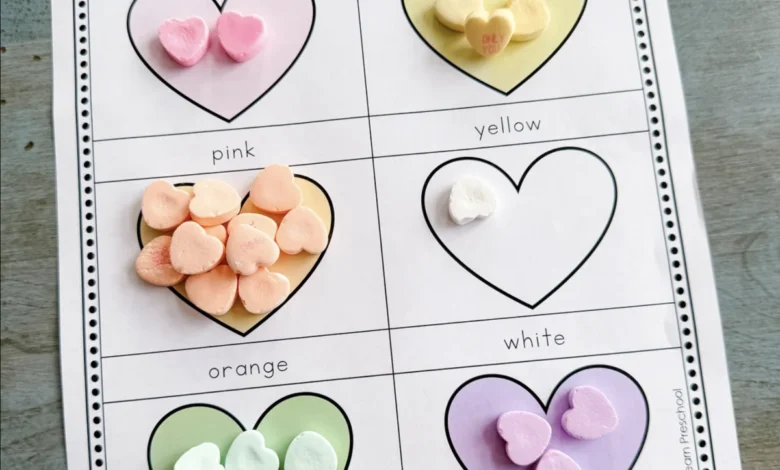
Maintaining academic momentum during the late winter months requires a careful balance between challenge and familiarity. Preschool math and literacy centers are designed to operate with a high degree of predictability. When children encounter familiar counting mats, sorting trays, and letter boards that have been subtly updated with seasonal aesthetics—such as counting hearts, sorting flowers, or measuring winter objects—they approach the tasks with pre-existing confidence.
Mathematics instruction in February heavily emphasizes subitizing, one-to-one correspondence, and basic quantification using small numbers. By limiting quantities and utilizing manipulatives that fit comfortably in small hands, educators ensure that mathematical concepts remain accessible. Literacy centers parallel this approach, pairing sight-word recognition and letter formation with tactile experiences that keep attention spans high.

Educational researchers note that this "familiar framework, new materials" strategy prevents burnout among both students and teachers. It allows children to work independently or in small collaborative groups, fostering the autonomy and self-regulation skills that are critical prerequisites for kindergarten readiness.
Dramatic Play as a Vehicle for Language and Social Development
Dramatic play centers remain one of the most vibrant components of the preschool environment, and their value peaks during months when children have developed strong peer dynamics and cooperative play strategies. In February, classrooms frequently transform dramatic play areas into flower shops, post offices, or community bakeries themed around seasonal gifting and communication.

Open-ended dramatic play spaces provide a natural context for children to negotiate roles, establish rules, and use language for authentic, real-world purposes. In a post office dramatic play setup, for instance, children dictate letters, apply stamps, sort mail by recipient, and deliver parcels to classmates. This immersive play seamlessly integrates early writing, counting, and social etiquette without requiring direct instructional oversight.
Developmental psychologists emphasize that dramatic play is a critical vehicle for executive function development. As children plan narratives, inhibit impulses to fit their chosen roles, and creatively solve problems that arise during play, they are exercising the prefrontal cortex in ways that structured desk work simply cannot replicate. The flexibility inherent in these centers ensures that children of varying developmental levels can participate meaningfully at their own pace.
Implications and Broader Impact on Early Childhood Education

The operational strategies deployed in preschool classrooms during February offer valuable insights into effective early childhood pedagogy as a whole. By prioritizing routine, reinforcing foundational skills through seasonal variations, and maintaining a strong focus on social-emotional competence, educators create an environment where children can consolidate the learning that has taken place over the fall and early winter months.
As educational policymakers and school districts continue to evaluate kindergarten readiness metrics, the emphasis on predictable, play-based, and socially integrated preschool environments remains paramount. Data suggests that children who experience a balanced, low-stress winter curriculum characterized by rich peer interactions and hands-on academic exploration transition into formal schooling with higher self-efficacy, stronger foundational literacy and numeracy skills, and a more robust capacity for emotional regulation.
Ultimately, February serves as a crucial bridge in the preschool year. It is a period where the foundational habits established in the autumn are refined, tested, and deeply integrated, setting the stage for the growth and exploration that will characterize the remainder of the academic calendar.
Related posts: