Heart Art on the Light Table: Illuminating Early Childhood Classrooms Through Sensory and Spatial Play

The integration of light tables into early childhood education settings has accelerated significantly over the past decade, shifting from a specialized sensory novelty into a foundational pedagogical tool across preschools nationwide. Educational researchers and early childhood specialists have long documented the cognitive benefits of translucent materials paired with backlit surfaces, noting how illumination captures young attention spans and enhances visual-spatial processing. As educators continually seek low-preparation, high-impact activities that align with seasonal themes, the intersection of geometry, color theory, and tactile art has materialized in innovative ways. A prominent example of this educational trend is the Valentine-themed "Heart Art on the Light Table" curriculum, an exercise designed to merge shape recognition with foundational scientific exploration. By utilizing simple, translucent materials on a glowing surface, teachers are transforming standard classroom corners into dynamic laboratories of early childhood development.

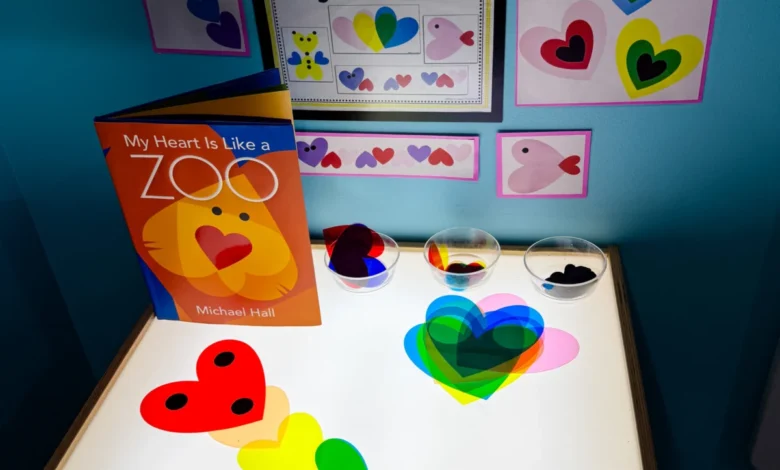
The operational framework of the light table activity relies on minimal preparation, a feature heavily favored by early childhood educators balancing rigorous daily schedules. Typically requiring only a light panel, a collection of translucent colored plastic or acrylic hearts in varying sizes, and basic sorting trays, the setup takes mere minutes. Once activated, the ambient glow of the table draws students organically to the center. Rather than following strict instructional templates, children are given autonomy to arrange, overlap, and stack the geometric shapes. This open-ended approach is rooted in constructivist learning theories, which posit that children construct knowledge best through direct interaction with their environment and materials.
From a developmental standpoint, the exercise serves as a multifaceted learning module. As children select, sort, and arrange the hearts, they engage in size recognition and comparative measurement—early mathematical concepts that lay the groundwork for more advanced geometry. Furthermore, the activity introduces foundational color theory in a tangible format. Because the hearts are fabricated from translucent materials of various hues, overlapping two distinct shapes—such as a yellow heart placed over a blue heart—creates an immediate visual demonstration of secondary color mixing, resulting in green. According to early childhood developmental milestones, experiential lessons of this nature yield higher rates of concept retention compared to two-dimensional textbook instruction.

Beyond cognitive milestones, the light table environment fosters critical social and emotional growth. Classroom observations from preschool educators indicate that backlit surfaces naturally encourage a calmer, more focused demeanor among young children compared to high-energy play zones. Working in close proximity around a localized glowing table promotes cooperative play. Students frequently share materials, negotiate design choices, and articulate their creative processes to peers. Educational psychologists note that these collaborative exchanges build essential language skills, expand vocabulary regarding spatial and color descriptors, and strengthen peer relationships through shared creative endeavors.
The broader implications of incorporating luminous sensory tools into early childhood curricula extend well beyond seasonal holiday units. As modern educational standards increasingly emphasize STEM (Science, Technology, Engineering, and Math) integration even at the preschool level, early childhood programs are challenged to introduce scientific concepts through age-appropriate modalities. Light and optics, typically reserved for upper-grade physics curricula, find an accessible entry point in light table play. By observing how light passes through various mediums, how shadows are cast, and how colors refract and combine, young learners engage in early scientific inquiry.

Administrators and curriculum developers have responded favorably to the widespread adoption of these low-cost, high-yield learning centers. Funding for specialized classroom equipment has historically been a point of contention, but the longevity and versatility of light tables—adaptable for autumn leaves, winter snowflakes, spring geometry, and summer patterns—represent a high return on investment for early learning institutions. Furthermore, the adaptability of such centers ensures that classrooms can easily meet diverse learning needs, accommodating both neurotypical children and those requiring specialized sensory integration therapies.
As early childhood education continues to evolve, balancing digital distractions with tactile, hands-on learning remains a primary objective for educators. Activities like the light table heart art project demonstrate that meaningful educational engagement does not require complex technology or expensive apparatuses. By harnessing basic physics, geometric shapes, and collaborative spaces, classrooms can provide an enriching environment where fundamental academic concepts are absorbed naturally through play, setting a robust foundation for future academic success.
Related posts: