February Preschool Activities: Maximizing Classroom Efficiency Through Familiar Routines and Hands-On Learning

As the winter season progresses into its final full month, early childhood educators across the country are discovering that February offers a uniquely stable environment within preschool classrooms. By this point in the academic year, young children have fully internalized daily routines, transitions, and classroom expectations. According to developmental specialists and early childhood curriculum coordinators, this established familiarity significantly reduces behavioral friction, creating an optimal window for deep cognitive engagement, extended peer interactions, and targeted skill development.
Background and Context of Mid-Year Early Childhood Education

The operational dynamics of preschool classrooms typically shift between January and February. During the autumn months, the primary focus centers on socialization, separation anxiety management, and the baseline establishment of institutional norms. By February, these foundational elements are firmly in place. Consequently, educators report a measurable decrease in transitional anxiety and behavioral disruptions.
Data compiled by early learning associations indicate that classrooms operating with predictable daily structures experience up to thirty percent fewer transition-related delays. This administrative and pedagogical efficiency frees up vital minutes in the daily schedule. Rather than spending time instructing students on how to navigate new tools or unfamiliar physical layouts, teachers can leverage these reclaimed moments for open-ended conversations, exploratory play, and repetitive practice of core academic benchmarks.
Strategic Curriculum Design: Repetition Over Novelty

A common pitfall in early education curriculum planning is the impulse to introduce entirely novel themes and complex materials every month. However, educational researchers advocate for a strategic shift during February: keeping core materials familiar while introducing subtle seasonal variations. This approach, often referred to by curriculum specialists as "scaffolded familiarity," maintains student interest without cognitive overload.
When children encounter familiar manipulatives—such as sorting trays, counting bears, or tracing boards—paired with a fresh seasonal motif, their brains do not have to decode how the material works. Instead, cognitive energy is directed straight toward the underlying mathematical or literacy concept. February preschool activities thus rely heavily on the pedagogical power of repetition, utilizing hands-on experiences that seamlessly integrate into existing classroom frameworks.
Valentine’s Day Frameworks: Moving Beyond Traditional Crafts

Historically, Valentine’s Day in early education settings has been synonymous with mass-produced card exchanges, sugary treats, and high-mess craft projects. However, modern educational standards are pivoting away from consumption-driven celebrations in favor of activities centered on communication, connection, and foundational literacy.
Educators are increasingly replacing generic parties with targeted
learning stations. For example, classrooms are utilizing Valentine-themed alphabet writing cards, which feature uppercase letters, guided tracing lines, dry-erase markers, and heart-shaped tactile manipulatives. These tools allow children to refine their fine-motor pinches and hand-eye coordination while simultaneously reinforcing letter recognition and name-writing skills.

Furthermore, early literacy specialists recommend integrating rhyming puzzles and thematic matching games during mid-February. Phonological awareness—the ability to recognize and manipulate spoken parts of sentences and words, such as syllables, onset, and rime—is a critical precursor to formal reading. By utilizing heart-shaped or seasonally decorated puzzle pieces that require children to match rhyming word pairs, educators provide multisensory reinforcement of literacy concepts without sacrificing the playful nature of the preschool environment.
Promoting Social-Emotional Growth Through Kindness Units
February’s cultural association with affection makes it an ideal month to formalize instruction surrounding emotional intelligence, empathy, and conflict resolution. Social-emotional learning (SEL) has become a paramount focus in preschool education, with numerous school districts mandating explicit kindness curricula.

Child development experts emphasize that lessons in friendship and sharing are most effective when they are reactive to real-time classroom occurrences rather than taught in isolation. Teachers are utilizing daily "Kindness Circles" to help children articulate their feelings, identify emotional cues in peers, and practice cooperative problem-solving.
According to classroom observations from early childhood behavioral analysts, embedding SEL frameworks into standard morning meetings yields significant dividends. Children who regularly practice structured sharing and verbal validation during preschool exhibit stronger emotional regulation capabilities as they transition into kindergarten and elementary school environments.
Winter Science and Empirical Observation

While retail environments frequently pivot toward spring by mid-February, actual meteorological conditions across many regions remain firmly wintry. This environmental reality provides an accessible, tangible laboratory for early science education.
Preschool science standards prioritize empirical observation over abstract theoretical concepts. In February classrooms, this translates to hands-on investigations involving ice, temperature, and material states. Popular activities include setting up ice cube sensory tables equipped with magnifying tools, pipettes, salt, warm water, and paintbrushes.
Through these investigations, young learners engage in the scientific method at an elementary level. They observe cause-and-effect relationships (such as how salt or warm water accelerates the melting process), record qualitative data through verbal descriptions, and begin to grasp basic thermodynamic concepts in a concrete, observable format. Educators report that these observational exercises significantly enhance descriptive vocabulary and critical thinking skills among four- and five-year-olds.

Integrating Math and Literacy Centers
Maintaining consistency in math and literacy centers during February allows educators to deepen academic rigor without inducing student frustration. When center layouts remain constant, children enter the space with built-in autonomy.
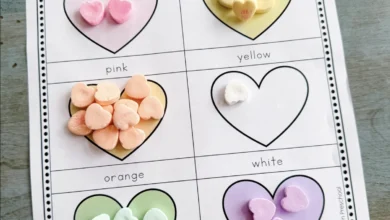
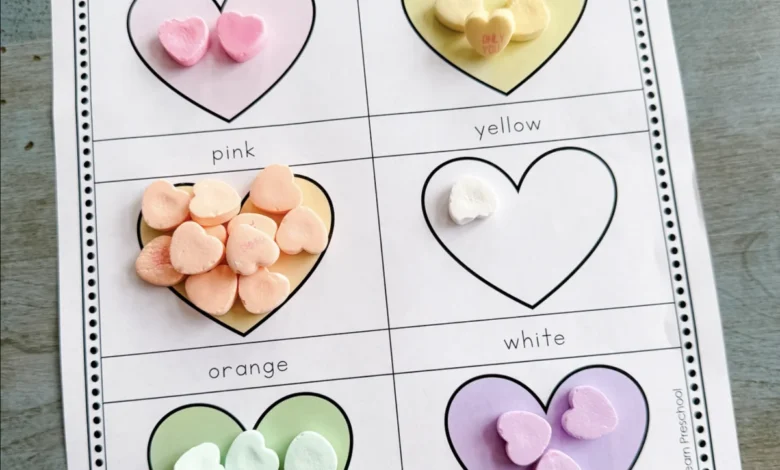
Key mathematical competencies emphasized during this period include one-to-one correspondence, subitizing, and simple set recognition. By utilizing thematic counting mats—such as placing the correct number of paper "flower petals" or "Valentine counters" onto a designated grid—children practice foundational arithmetic within controlled parameters. Keeping numbers small (typically ranging from one to ten) ensures that every child achieves a high rate of success, thereby fostering intrinsic academic confidence.

Similarly, literacy centers benefit from small, thematic adjustments. Alphabet matching games, sight-word recognition charts embedded with seasonal graphics, and tactile tracing trays allow students to practice foundational reading skills independently. Educational data consistently shows that independent center-based learning reinforces teacher-led instruction, ensuring higher rates of concept retention.
Dramatic Play as a Vehicle for Language Development
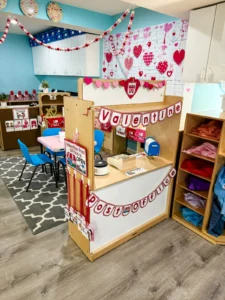
Dramatic play centers remain a cornerstone of high-quality preschool education. In February, these spaces frequently transform into specialized interactive environments, such as a classroom "Flower Shop" or a community "Post Office."

These open-ended dramatic play setups are not merely recreational; they serve as critical vehicles for pragmatic language development. Within these simulated environments, children must negotiate roles, establish rules of play, articulate narratives, and navigate interpersonal disagreements without direct adult intervention.
Speech and language pathologists note that socio-dramatic play encourages the use of complex sentence structures, conditional phrasing, and collaborative vocabulary. When a child takes on the role of a postal worker selling Valentine cards or a florist arranging bouquets, they are required to use language for explicit, functional purposes. This social negotiation builds verbal fluency and deepens peer relationships in a low-stakes, highly engaging setting.
Implications and Future Outlook for Early Education

The pedagogical strategies implemented in February set a definitive baseline for the remainder of the school year. By capitalizing on established classroom routines, minimizing unnecessary disruptions, and prioritizing high-engagement, low-overhead material changes, educators create an environment where children can consolidate their learning.
As educational standards continue to evolve toward a balanced approach that weights social-emotional development equally with academic preparedness, months like February demonstrate the value of intentional, structured continuity. Experts conclude that maintaining a steady, supportive rhythm in early childhood classrooms ultimately yields more resilient, confident, and academically prepared learners as they approach the transition to primary education.